Skip to main content
GOB Chemistry
My Course
Learn
Exam Prep
AI Tutor
Study Guides
Textbook Solutions
Flashcards
Explore
Try the app
My Course
Learn
Exam Prep
AI Tutor
Study Guides
Textbook Solutions
Flashcards
Explore
Try the app
Back
Intro to Enzymes definitions
You can tap to flip the card.
Enzyme
You can tap to flip the card.
👆
Enzyme
Protein or non-protein molecule that accelerates biochemical reactions without being changed or consumed.
Track progress
Control buttons has been changed to "navigation" mode.
1/12
Related flashcards
Related practice
Recommended videos
Intro to Enzymes quiz
Intro to Enzymes
15 Terms
Intro to Enzymes
19. Enzymes
6 problems
Topic
Laura
Enzyme Classification
19. Enzymes
7 problems
Topic
KeyshawnDavis
19. Enzymes
9 topics
15 problems
Chapter
Laura
Guided course
2:14
Intro to Enzymes Concept 1
2501
views
5
rank
Guided course
1:00
Intro to Enzymes Example 1
2390
views
10
rank
Terms in this set (12)
Hide definitions
Enzyme
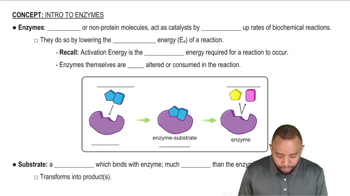
Protein or non-protein molecule that accelerates biochemical reactions without being changed or consumed.
Catalyst
Agent that increases the rate of a chemical reaction by lowering the required activation energy.
Activation Energy
Minimum energy needed for a reaction to begin, often reduced by the presence of a catalyst.
Substrate
Reactant molecule that binds to a catalyst and is transformed into different products.
Product
Molecule or molecules formed as a result of a chemical transformation involving a catalyst.
Enzyme-Substrate Complex
Temporary structure formed when a reactant binds to a catalyst, enabling transformation into products.
Biochemical Reaction
Chemical process occurring within living organisms, often accelerated by specific protein molecules.
Protein
Large biomolecule composed of amino acids, often functioning as a biological catalyst in cells.
Reactant
Initial molecule that undergoes chemical change during a reaction, often interacting with a catalyst.
Transformation
Process in which a reactant is converted into one or more different molecules during a reaction.
Structure
Three-dimensional arrangement of atoms in a molecule, crucial for the function of biological catalysts.
Rate
Speed at which a chemical process occurs, often increased by the presence of a catalyst.
 BackBack
 2:14
2:14