Skip to main content
GOB Chemistry
My Course
Learn
Exam Prep
AI Tutor
Study Guides
Textbook Solutions
Flashcards
Explore
Try the app
My Course
Learn
Exam Prep
AI Tutor
Study Guides
Textbook Solutions
Flashcards
Explore
Try the app
Back
Intro to Enzymes quiz
You can tap to flip the card.
What role do enzymes play in biochemical reactions?
You can tap to flip the card.
👆
What role do enzymes play in biochemical reactions?
Enzymes act as catalysts by speeding up the rates of biochemical reactions.
Track progress
Control buttons has been changed to "navigation" mode.
1/15
Related flashcards
Related practice
Recommended videos
Intro to Enzymes definitions
Intro to Enzymes
12 Terms
Intro to Enzymes
19. Enzymes
6 problems
Topic
Laura
Enzyme Classification
19. Enzymes
7 problems
Topic
KeyshawnDavis
19. Enzymes
9 topics
15 problems
Chapter
Laura
Guided course
2:14
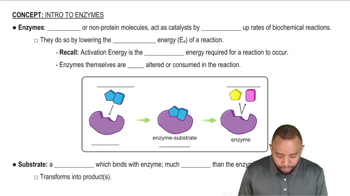
Intro to Enzymes Concept 1
2501
views
5
rank
Guided course
1:00
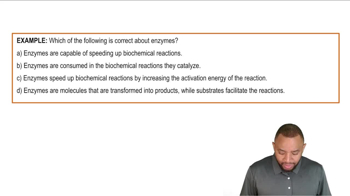
Intro to Enzymes Example 1
2390
views
10
rank
Terms in this set (15)
Hide definitions
What role do enzymes play in biochemical reactions?
Enzymes act as catalysts by speeding up the rates of biochemical reactions.
How do enzymes speed up chemical reactions?
They lower the activation energy required for the reaction to occur.
What is activation energy in the context of enzyme reactions?
Activation energy is the minimum energy required for a reaction to take place.
Are enzymes altered or consumed during the reactions they catalyze?
No, enzymes are not altered or consumed and remain unchanged after the reaction.
What is a substrate in an enzyme-catalyzed reaction?
The substrate is the reactant that binds with the enzyme.
How does the size of the substrate compare to the enzyme?
The substrate is much smaller than the enzyme.
What happens to the substrate during an enzyme-catalyzed reaction?
The substrate is transformed into products while interacting with the enzyme.
What is formed when a substrate binds to an enzyme?
An enzyme-substrate complex is formed.
What happens to the enzyme after the reaction is complete?
The enzyme returns to its original structure and can be reused.
What happens to the substrate after the reaction is complete?
The substrate is converted into new products.
Why are enzymes considered catalysts?
Because they speed up reactions without being consumed or changed.
What does the enzyme-substrate complex allow to happen?
It allows the substrate to be transformed into products efficiently.
Can enzymes be proteins or non-protein molecules?
Yes, enzymes can be either protein or non-protein molecules.
What is the significance of the enzyme not being altered in a reaction?
It means the enzyme can participate in multiple reactions without being used up.
How do enzymes affect the transformation of substrates?
Enzymes help speed up the transformation of substrates into products.
 BackBack
 2:14
2:14