Skip to main content
GOB Chemistry
My Course
Learn
Exam Prep
AI Tutor
Study Guides
Textbook Solutions
Flashcards
Explore
Try the app
My Course
Learn
Exam Prep
AI Tutor
Study Guides
Textbook Solutions
Flashcards
Explore
Try the app
Back
Intro to Lipid Digestion definitions
You can tap to flip the card.
Triacylglycerol
You can tap to flip the card.
👆
Triacylglycerol
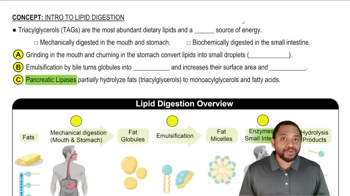
Most abundant dietary lipid, serving as a rich energy source, composed of three fatty acids linked to glycerol.
Track progress
Control buttons has been changed to "navigation" mode.
1/14
Related flashcards
Related practice
Recommended videos
Intro to Lipid Digestion quiz
Intro to Lipid Digestion
15 Terms
Intro to Lipid Digestion quiz
Intro to Lipid Digestion
15 Terms
Intro to Lipid Digestion
24. Lipid Metabolism
2 problems
Topic
KeyshawnDavis
Digestion of Lipids
24. Lipid Metabolism
3 problems
Topic
Nicole
24. Lipid Metabolism - Part 1 of 2
8 topics
15 problems
Chapter
KeyshawnDavis
24. Lipid Metabolism - Part 2 of 2
1 topic
3 problems
Chapter
Nicole
Guided course
1:34
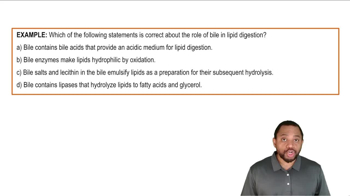
Intro to Lipid Digestion Example 1
2202
views
1
rank
Guided course
2:54
Intro to Lipid Digestion Concept 1
2244
views
Terms in this set (14)
Hide definitions
Triacylglycerol
Most abundant dietary lipid, serving as a rich energy source, composed of three fatty acids linked to glycerol.
Mechanical Digestion
Physical breakdown of fats in the mouth and stomach, producing smaller droplets called globules.
Globule
Small droplet formed from larger fat particles during initial physical breakdown in the digestive tract.
Small Intestine
Primary site for biochemical breakdown of dietary fats, where most lipid digestion occurs.
Bile
Digestive fluid containing bile salts and phospholipids, crucial for emulsifying dietary fats.
Bile Salt
Component of bile that acts as an emulsifying agent, aiding in the transformation of fat globules into micelles.
Emulsification
Process where bile salts disperse fat globules into micelles, increasing surface area and solubility.
Micelle
Tiny, soluble particle formed from emulsified fats, facilitating absorption in the small intestine.
Pancreatic Lipase
Enzyme secreted into the small intestine that hydrolyzes triacylglycerols into monoacylglycerols and fatty acids.
Monoacylglycerol
Product of partial hydrolysis of triacylglycerols, containing a single fatty acid attached to glycerol.
Fatty Acid
Molecule released from triacylglycerol hydrolysis, serving as a key energy source and metabolic intermediate.
Ester Linkage
Chemical bond connecting fatty acids to glycerol in triacylglycerols, targeted during lipid hydrolysis.
Hydrolysis
Chemical reaction involving water that breaks ester linkages in fats, yielding monoacylglycerols and fatty acids.
Phospholipid
Component of bile that assists in emulsifying fats, enhancing the formation of micelles.
 BackBack
 1:34
1:34