Back

Naming Amides definitions

Control buttons has been changed to "navigation" mode.
1/13
  • Amide

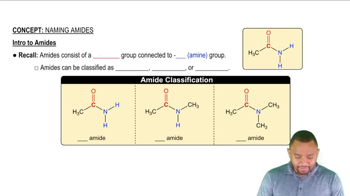
    A molecule featuring a carbonyl group bonded directly to a nitrogen, often derived from an amine.
  • Carbonyl Group

    A functional group consisting of a carbon atom double-bonded to an oxygen atom, central to amide structure.
  • Nitrogen

    An atom in amides directly bonded to the carbonyl group, determining classification as primary, secondary, or tertiary.
  • Primary Amide

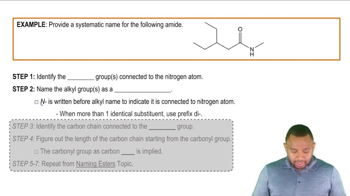
    A type where only one carbon is directly attached to the nitrogen atom.
  • Secondary Amide

    A type where two carbons are directly attached to the nitrogen atom.
  • Tertiary Amide

    A type where three carbons are directly attached to the nitrogen atom.
  • IUPAC Naming

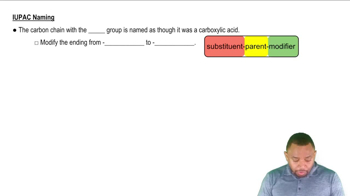
    A systematic method where the parent chain is named like a carboxylic acid, but the ending changes to 'amide'.
  • Common Naming

    A method using traditional prefixes for the parent chain and modifying 'oic acid' to 'amide'.
  • Substituent

    A group or atom attached to the main structure, such as those bonded to the nitrogen in amides.
  • Parent Chain

    The longest continuous chain containing the carbonyl group, serving as the base for naming.
  • N-Substituent

    A group attached directly to the nitrogen atom, indicated with an 'N-' prefix in naming.
  • Carboxylic Acid

    A compound whose naming conventions are adapted for amides by replacing 'oic acid' with 'amide'.
  • Prefix

    A word part added before the parent chain name to indicate the nature or position of substituents.