Back

Naming Amides quiz

Control buttons has been changed to "navigation" mode.
1/15
  • What functional groups characterize an amide?

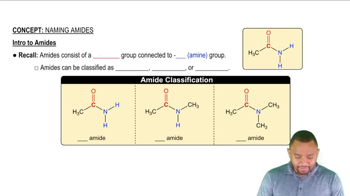
    An amide is characterized by a carbonyl group connected to a nitrogen atom.
  • How are amides classified as primary, secondary, or tertiary?

    Amides are classified based on the number of carbons directly attached to the nitrogen: one for primary, two for secondary, and three for tertiary.
  • What is a primary amide?

    A primary amide has only one carbon directly attached to the nitrogen atom.
  • How many carbons are attached to the nitrogen in a secondary amide?

    A secondary amide has two carbons directly attached to the nitrogen.
  • What defines a tertiary amide?

    A tertiary amide has three carbons directly attached to the nitrogen atom.
  • In IUPAC naming, how is the parent chain of an amide determined?

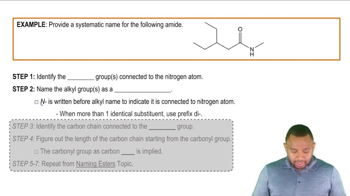
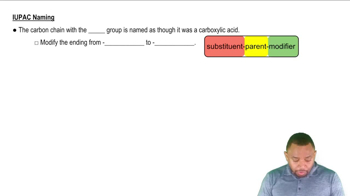
    The parent chain is the carbon chain containing the carbonyl group, named as if it were a carboxylic acid.
  • How is the ending of a carboxylic acid name changed to form an amide name in IUPAC?

    The ending 'oic acid' is replaced with 'amide' in the IUPAC name.
  • How are substituents on the nitrogen atom indicated in IUPAC amide names?

    Substituents on the nitrogen are included in the name and are prefixed with 'N-'.
  • What is the main difference between IUPAC and common naming of amides?

    IUPAC uses systematic parent chain names, while common naming uses common prefixes for the parent chain.
  • How are substituents on nitrogen listed in common naming of amides?

    They are listed alphabetically and each is prefixed with 'N-'.
  • What is the common name prefix for a three-carbon amide parent chain?

    The common name prefix for a three-carbon chain is 'propion'.
  • How would you name an amide with a butyl and a methyl group on the nitrogen using common naming?

    List the substituents alphabetically as 'N-butyl-N-methyl', followed by the parent chain name and 'amide'.
  • What is the origin of the nitrogen in an amide?

    The nitrogen in an amide may originate from an amine group.
  • What is the suffix used for amides in both IUPAC and common naming?

    The suffix 'amide' is used in both IUPAC and common naming.
  • When naming amides, what is modified from the carboxylic acid name?

    The ending 'oic acid' is changed to 'amide' to name the compound as an amide.