Back

Naming Dienes and Trienes definitions

Control buttons has been changed to "navigation" mode.
1/13
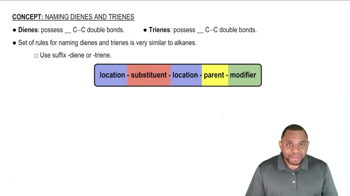
  • Diene

    A hydrocarbon structure featuring exactly two carbon-carbon double bonds within its main chain.
  • Triene

    A hydrocarbon molecule characterized by the presence of three carbon-carbon double bonds in its main chain.
  • Double Bond

    A type of covalent bond where two pairs of electrons are shared between two carbon atoms, increasing reactivity.
  • Suffix

    A word ending, such as '-diene' or '-triene', used to indicate the number of double bonds in a hydrocarbon.
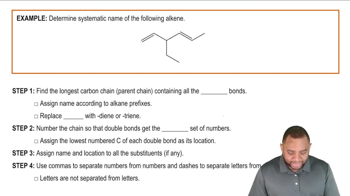
  • Substituent

    An atom or group attached to the main carbon chain, whose position must be specified in compound naming.
  • Main Chain

    The longest continuous sequence of carbon atoms in a molecule, serving as the base for naming.
  • Parent Chain

    The principal carbon chain selected for nomenclature, containing the maximum number of double bonds.
  • Nomenclature

    A systematic method for assigning names to chemical compounds based on structure and bonding.
  • Hydrocarbon

    An organic compound consisting solely of hydrogen and carbon atoms, forming the basis for dienes and trienes.
  • Conjugated System

    A molecular arrangement where alternating single and double bonds allow for electron delocalization.
  • Addition Reaction

    A chemical process where atoms are added to a molecule, often at double bonds, altering its structure.
  • Unsaturated Hydrocarbon

    A molecule containing one or more double bonds, resulting in fewer hydrogen atoms than alkanes.
  • Modifier

    A component in a compound's name, such as '-diene' or '-triene', indicating structural features.