Skip to main content
GOB Chemistry
My Course
Learn
Exam Prep
AI Tutor
Study Guides
Textbook Solutions
Flashcards
Explore
Try the app
My Course
Learn
Exam Prep
AI Tutor
Study Guides
Textbook Solutions
Flashcards
Explore
Try the app
Back
Naming Ethers quiz
You can tap to flip the card.
What is the general structure of an ether?
You can tap to flip the card.
👆
What is the general structure of an ether?
An ether consists of an oxygen atom connected to two alkyl groups.
Track progress
Control buttons has been changed to "navigation" mode.
1/15
Related flashcards
Related practice
Recommended videos
Naming Ethers definitions
Naming Ethers
12 Terms
Naming Ethers
14. Compounds with Oxygen or Sulfur
5 problems
Topic
Jules
Naming Thiols
14. Compounds with Oxygen or Sulfur
2 problems
Topic
Jules
14. Compounds with Oxygen or Sulfur
7 topics
15 problems
Chapter
Jules
Guided course
1:15
Naming Ethers Example 1
3147
views
6
rank
Guided course
0:35
IUPAC Rules for Naming Ethers Concept 2
2860
views
3
rank
Guided course
2:50
IUPAC Rules for Naming Ethers Example 2
2883
views
6
rank
Terms in this set (15)
Hide definitions
What is the general structure of an ether?
An ether consists of an oxygen atom connected to two alkyl groups.
How does the common naming system for ethers end?
The common naming system for ethers ends with the parent name 'ether.'
How are the alkyl groups used in the common naming of ethers?
The names of the alkyl substituents are listed at the beginning, followed by 'ether.'
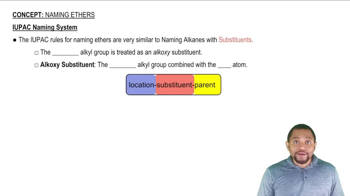
What is an alkoxy substituent in the context of ethers?
An alkoxy substituent is the smaller alkyl group combined with the oxygen atom.
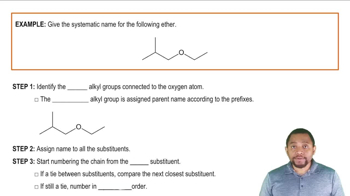
According to IUPAC rules, how is the smaller alkyl group in an ether treated?
The smaller alkyl group is treated as an alkoxy substituent in IUPAC naming.
What does the IUPAC naming of ethers involve specifying?
It involves specifying the location of substituents, including the alkoxy group, followed by the parent name.
How are ethers similar to alkanes in IUPAC naming?
Ethers are named similarly to alkanes with substituents under IUPAC rules.
What is the unique approach to naming ethers?
The unique approach is to list the alkyl substituents first and end with 'ether.'
What is the parent name used in the common naming of ethers?
The parent name used is 'ether.'
In IUPAC naming, what is the role of the alkoxy group?
The alkoxy group acts as a substituent on the main carbon chain.
When naming ethers, which group is considered the parent chain in IUPAC?
The larger alkyl group is considered the parent chain.
How do you determine which alkyl group becomes the alkoxy substituent?
The smaller alkyl group becomes the alkoxy substituent.
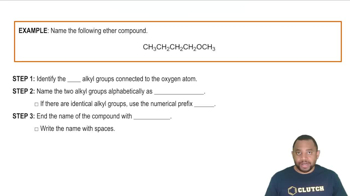
What is the general formula for naming ethers in the common system?
The general formula is: alkyl group 1 + alkyl group 2 + ether.
What is the function of the oxygen atom in ethers?
The oxygen atom connects two alkyl groups in ethers.
Why do ethers have a unique naming system?
Because they have an oxygen atom bonded to two alkyl groups, requiring a distinct naming approach.
 BackBack
 1:15
1:15