Back

Naming Monoatomic Cations quiz

Control buttons has been changed to "navigation" mode.
1/15
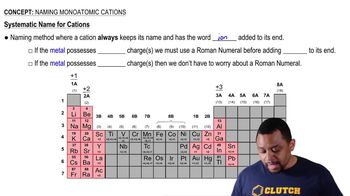
  • How do you name a monoatomic cation with only one possible charge?

    You use the element's name followed by 'ion' without a Roman numeral (e.g., magnesium ion).
  • What is the systematic name for a vanadium ion with a 3+ charge?

    It is called vanadium(III) ion.
  • When do you use Roman numerals in naming cations?

    Roman numerals are used when the metal can have multiple possible charges to indicate the specific charge.
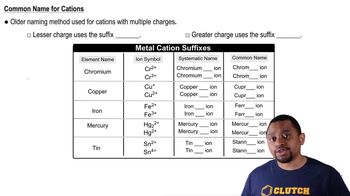
  • What suffix is used in the older naming system for the lower charge of a cation?

    The suffix '-ous' is used for the lower charge.
  • What suffix is used in the older naming system for the higher charge of a cation?

    The suffix '-ic' is used for the higher charge.
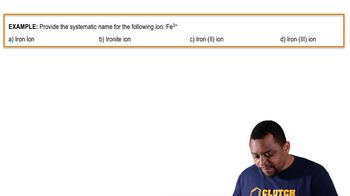
  • What is the common name for Fe2+?

    The common name is ferrous ion.
  • What is the common name for Fe3+?

    The common name is ferric ion.
  • What is the systematic name for Cu+?

    The systematic name is copper(I) ion.
  • What is the common name for Cu2+?

    The common name is cupric ion.
  • Why do some cation names use Latin roots in their common names?

    Because the element symbols and common names are based on their Latin names, such as 'cuprum' for copper and 'ferrum' for iron.
  • How is mercury(I) ion unique among cations?

    Mercury(I) exists as a pair of ions with a combined charge of 2+, so each mercury ion has a +1 charge.
  • What are the common names for Hg2+ and Hg+?

    Hg+ is called mercurous ion, and Hg2+ is called mercuric ion.
  • What is the systematic name for Sn4+?

    The systematic name is tin(IV) ion.
  • What are the common names for Sn2+ and Sn4+?

    Sn2+ is stannous ion, and Sn4+ is stannic ion.
  • For which groups of metals do you not need to use Roman numerals when naming their cations?

    You do not need Roman numerals for metals in groups 1A, 2A, and 3A, as they have only one possible charge.