Skip to main content
GOB Chemistry
My Course
Learn
Exam Prep
AI Tutor
Study Guides
Textbook Solutions
Flashcards
Explore
Try the app
My Course
Learn
Exam Prep
AI Tutor
Study Guides
Textbook Solutions
Flashcards
Explore
Try the app
Back
Peptides definitions
You can tap to flip the card.
Peptide
You can tap to flip the card.
👆
Peptide
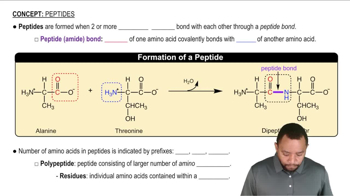
A molecule formed by linking two or more amino acids through covalent bonds, often represented by three-letter codes joined by hyphens.
Track progress
Control buttons has been changed to "navigation" mode.
1/15
Related flashcards
Related practice
Recommended videos
Peptides quiz
Peptides
15 Terms
Peptides
18. Amino Acids and Proteins
7 problems
Topic
Jules
Primary Protein Structure
18. Amino Acids and Proteins
6 problems
Topic
Jules
18. Amino Acids and Proteins - Part 1 of 2
6 topics
13 problems
Chapter
Jules
18. Amino Acids and Proteins - Part 2 of 2
5 topics
13 problems
Chapter
Jules
Guided course
1:18
Drawing & Naming Peptides Concept 2
3251
views
4
rank
Guided course
3:07
Peptides Concept 1
3298
views
5
rank
Guided course
1:24
Peptides Example 1
3250
views
4
rank
Terms in this set (15)
Hide definitions
Peptide
A molecule formed by linking two or more amino acids through covalent bonds, often represented by three-letter codes joined by hyphens.
Amino Acid
A building block containing an amino group and a carboxyl group, which can link to others to form larger biomolecules.
Peptide Bond
A covalent linkage formed between the carboxyl group of one amino acid and the amino group of another, releasing water.
Amide Bond
A type of covalent bond identical to the linkage connecting amino acids in peptides, involving nitrogen and carbonyl carbon.
Condensation Reaction
A chemical process where two molecules join, resulting in the loss of a small molecule, typically water.
Carboxyl Group
A functional group with a carbon double-bonded to oxygen and single-bonded to a hydroxyl, key in peptide formation.
Amino Group
A functional group containing nitrogen bonded to hydrogens, essential for forming covalent links in peptides.
Dipeptide
A molecule consisting of two amino acids joined by a single covalent linkage.
Tripeptide
A chain composed of three amino acids connected by two covalent linkages.
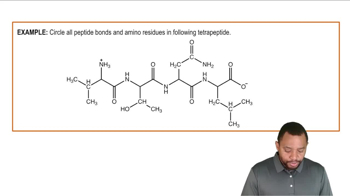
Tetrapeptide
A sequence of four amino acids linked together by three covalent bonds.
Polypeptide
A long chain composed of many amino acid residues, forming the backbone of proteins.
Residue
An individual amino acid unit within a peptide or protein chain after condensation.
N Terminus
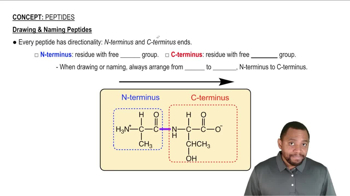
The end of a peptide chain with a free amino group, typically shown on the left in diagrams.
C Terminus
The end of a peptide chain with a free carboxyl group, usually depicted on the right in structures.
Directionality
The orientation of a peptide chain, always described from the free amino end to the free carboxyl end.
 BackBack
 1:18
1:18