GOB Chemistry
My Course
Learn
Exam Prep
AI Tutor
Study Guides
Textbook Solutions
Flashcards
Explore
My Course
Learn
Exam Prep
AI Tutor
Study Guides
Textbook Solutions
Flashcards
Explore
Back
Periodic Table: Phases (Simplified) quiz
You can tap to flip the card.
Define:
At what temperature and pressure are the standard states of elements typically discussed?
You can tap to flip the card.
👆
At what temperature and pressure are the standard states of elements typically discussed?
Standard states are discussed at 25 degrees Celsius and 1 atmosphere of pressure.
Track progress
Control buttons has been changed to "navigation" mode.
1/15
Related flashcards
Related practice
Recommended videos
Periodic Table: Phases (Simplified) definitions
Periodic Table: Phases (Simplified)
14 Terms
2. Atoms and the Periodic Table - Part 1 of 3
6 topics
14 problems
Chapter
Jules
2. Atoms and the Periodic Table - Part 2 of 3
12 topics
14 problems
Chapter
Jules
2. Atoms and the Periodic Table - Part 3 of 3
10 topics
14 problems
Chapter
Jules
Guided course
03:25
Periodic Table: Phases (Simplified) Concept 1
Jules
7047
views
52
rank
Guided course
02:07
Periodic Table: Phases (Simplified) Example 1
Jules
5269
views
46
rank
Terms in this set (15)
Hide definitions
At what temperature and pressure are the standard states of elements typically discussed?
Standard states are discussed at 25 degrees Celsius and 1 atmosphere of pressure.
How do the molecules in a solid behave at room temperature and pressure?
Molecules in a solid are locked in place and in direct contact with each other, maintaining a fixed shape and volume.
Why do solids maintain a fixed shape and volume?
Solids maintain a fixed shape and volume because their molecules are locked in place and cannot move freely.
How do liquids differ from solids in terms of molecular movement?
Liquid molecules are in close proximity but can move around each other, allowing them to conform to the shape of their container.
Why can't a liquid always fill the entire volume of its container?
A liquid can't fill the entire volume if there isn't enough of it, even though it can conform to the container's shape.
How do gases behave in terms of shape and volume?
Gases assume both the shape and volume of their container because their molecules are far apart.
Which state of matter has molecules that are farthest apart?
Gases have molecules that are farthest apart compared to solids and liquids.
What is the most common state of elements on the periodic table at room temperature?
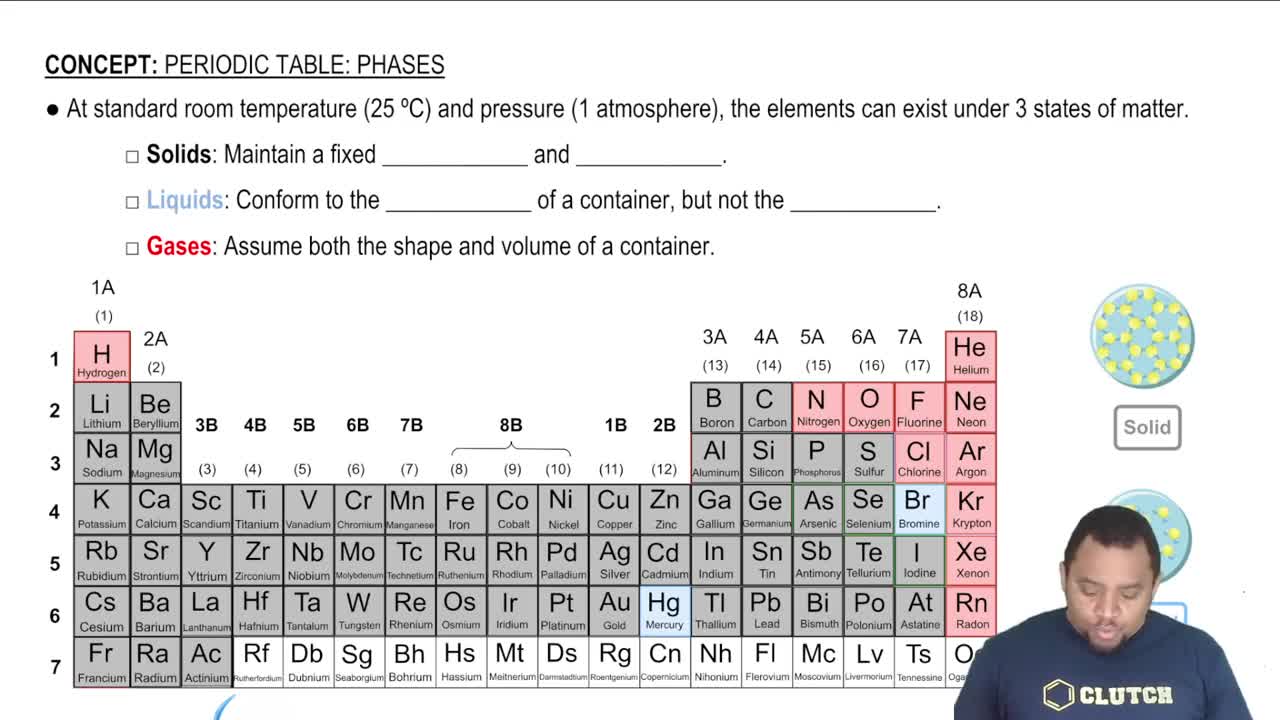
Most elements are solids at room temperature and pressure.
Name three elements that are solids at standard conditions.
Lithium, zinc, and sulfur are examples of elements that are solids at standard conditions.
Which elements are commonly found as gases at room temperature?
Hydrogen, nitrogen, oxygen, chlorine, and the noble gases are commonly found as gases.
What group on the periodic table are all gases at room temperature?
Group 8A, the noble gases, are all gases at room temperature.
Which two elements are liquids at standard room temperature and pressure?
Mercury and bromine are the only two elements that are liquids under standard conditions.
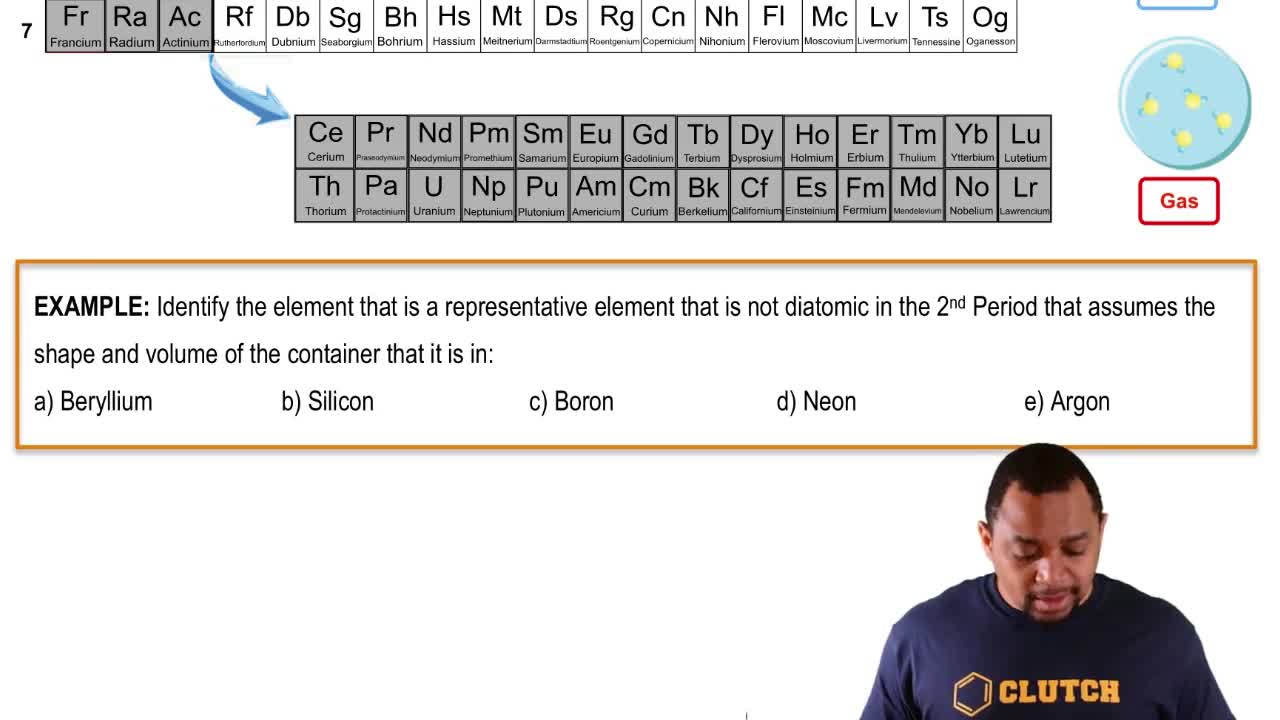
Why are the states of elements from Rf to Og not specified at standard conditions?
These elements are synthetic and highly unstable, making their state of matter unpredictable at standard conditions.
What is unique about the elements in the 7th row from Rf to Og?
They are synthetically made in laboratories and are very unstable.
How does temperature and pressure affect the state of matter of elements?
Different elements prefer different states of matter depending on the temperature and pressure.