Back

Quaternary Protein Structure definitions

Control buttons has been changed to "navigation" mode.
1/15
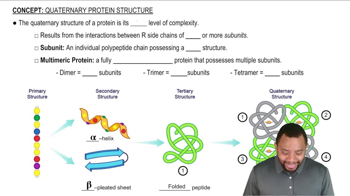
  • Quaternary Structure

    Highest protein complexity, formed by interactions among side chains of two or more polypeptide subunits.
  • Subunit

    Individual polypeptide chain with its own tertiary structure, contributing to a larger protein complex.
  • Multimeric Protein

    Functional protein composed of multiple subunits, each with its own tertiary structure.
  • Dimer

    Protein complex consisting of exactly two subunits interacting together.
  • Trimer

    Protein complex made up of three distinct subunits joined together.
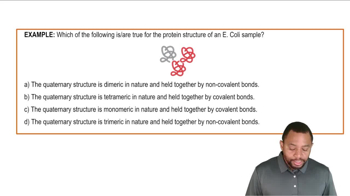
  • Tetramer

    Protein assembly containing four subunits, often forming a functional unit.
  • Primary Structure

    Linear sequence of amino acids in a polypeptide, linked by peptide bonds.
  • Secondary Structure

    Regular repeating patterns, such as alpha helices and beta sheets, within a single polypeptide chain.
  • Alpha Helix

    Coiled secondary structure stabilized by hydrogen bonds within the same polypeptide chain.
  • Beta Plated Sheet

    Sheet-like secondary structure formed by hydrogen bonds between different segments of a polypeptide.
  • Tertiary Structure

    Three-dimensional folding of a polypeptide due to interactions like hydrophobic effects and hydrogen bonds.
  • Hydrophobic Interaction

    Nonpolar side chains clustering away from water, driving protein folding and stability.
  • Hydrogen Bonding

    Attraction between a hydrogen atom and an electronegative atom, stabilizing protein structures.
  • Prosthetic Group

    Non-amino acid component, such as a heme group, essential for protein function in quaternary structures.
  • Heme Group

    Iron-containing prosthetic group in hemoglobin, crucial for oxygen transport in the body.