Skip to main content
GOB Chemistry
My Course
Learn
Exam Prep
AI Tutor
Study Guides
Textbook Solutions
Flashcards
Explore
Try the app
My Course
Learn
Exam Prep
AI Tutor
Study Guides
Textbook Solutions
Flashcards
Explore
Try the app
Back
Sphingomyelins definitions
You can tap to flip the card.
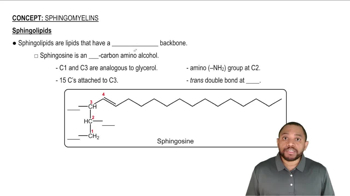
Sphingosine
You can tap to flip the card.
👆
Sphingosine
An 18-carbon amino alcohol forming the backbone of certain lipids, featuring a trans double bond and a long hydrocarbon chain.
Track progress
Control buttons has been changed to "navigation" mode.
1/15
Related flashcards
Related practice
Recommended videos
Sphingomyelins quiz
Sphingomyelins
15 Terms
Sphingomyelins
23. Lipids
3 problems
Topic
Nicole
Steroids
23. Lipids
3 problems
Topic
Nicole
23. Lipids - Part 1 of 3
6 topics
13 problems
Chapter
Ernest
23. Lipids - Part 2 of 3
6 topics
12 problems
Chapter
Nicole
23. Lipids - Part 3 of 3
1 topic
3 problems
Chapter
Guided course
3:11
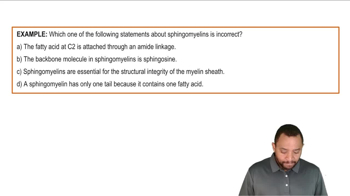
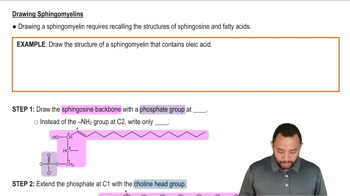
Sphingomyelins Example 2
2676
views
1
rank
Guided course
1:09
Sphingomyelins Example 1
2741
views
1
rank
Guided course
1:32
Sphingomyelins Concept 1
2795
views
Terms in this set (15)
Hide definitions
Sphingosine
An 18-carbon amino alcohol forming the backbone of certain lipids, featuring a trans double bond and a long hydrocarbon chain.
Sphingolipid
A lipid class defined by a sphingosine backbone, often involved in cell membrane structure and signaling.
Phospholipid
A molecule with both hydrophilic and hydrophobic regions, essential for forming biological membranes.
Fatty Acid
A long hydrocarbon chain attached via an amide bond, contributing to the dual-tail structure of certain lipids.
Phosphate Group
A polar, negatively charged group attached to the first carbon, forming part of the head in specific membrane lipids.
Choline
A positively charged head group containing nitrogen bonded to three methyl groups, crucial for membrane structure.
Amide Bond
A linkage where a carbonyl group is directly connected to a nitrogen, joining fatty acids to the backbone.
Myelin Sheath
A protective, insulating layer around nerve fibers, primarily composed of specialized lipids.
Trans Double Bond
A specific type of unsaturation at the fourth carbon, contributing to the rigidity of the lipid backbone.
Amino Group
A functional group consisting of nitrogen and hydrogen, located at the second carbon of the backbone.
Glycerol Analogy
A structural similarity where the first three carbons of the backbone resemble those in a common triol.
Nitrogen
An element in the head group, forming four bonds and carrying a positive charge in certain membrane lipids.
Hydrocarbon Chain
A 15-carbon segment extending from the third carbon, contributing to the hydrophobic tail.
Structural Component
A role in providing stability and integrity to cellular or nerve fiber membranes.
Nerve Fiber Coating
A function involving the insulation and protection of axons, essential for rapid signal transmission.
 BackBack

 3:11
3:11