Back

Spontaneous vs Nonspontaneous Reactions quiz

Control buttons has been changed to "navigation" mode.
1/15
  • What is a spontaneous reaction?

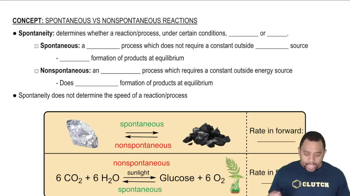
    A spontaneous reaction is a natural process that occurs without a constant outside energy source and favors the formation of products at equilibrium.
  • What is a nonspontaneous reaction?

    A nonspontaneous reaction requires a constant outside energy source to occur and favors the reactants at equilibrium.
  • Does spontaneity determine the speed of a reaction?

    No, spontaneity does not determine the speed of a reaction; it only indicates if the reaction can occur naturally.
  • What field of chemistry deals with spontaneity?

    Thermodynamics deals with spontaneity, determining if a reaction can occur or not.
  • What field of chemistry deals with reaction speed?

    Kinetics deals with the speed of a reaction.
  • Give an example of a spontaneous reaction that occurs very slowly.

    The conversion of diamond to graphite is a spontaneous reaction that takes millions of years to occur.
  • Is the conversion of graphite to diamond spontaneous or nonspontaneous?

    The conversion of graphite to diamond is nonspontaneous and requires a lot of energy input.
  • What is required for a nonspontaneous reaction to occur?

    A nonspontaneous reaction requires a constant flow of outside energy to proceed.
  • What is an example of a nonspontaneous reaction in nature?

    Photosynthesis is a nonspontaneous reaction because it requires sunlight as an outside energy source.
  • What is the reverse process of photosynthesis and is it spontaneous?

    The reverse process is cellular respiration, which is spontaneous and occurs naturally.
  • If a reaction is spontaneous in one direction, what can be said about the reverse reaction?

    If a reaction is spontaneous in one direction, the reverse reaction is nonspontaneous.
  • What are the three main thermodynamic concepts related to spontaneity?

    The three main concepts are free-energy change (ΔG), entropy (ΔS), and enthalpy (ΔH).
  • Can a spontaneous reaction take a very long time to occur?

    Yes, a spontaneous reaction can take millions of years to occur; speed does not affect spontaneity.
  • What happens to product formation at equilibrium in a spontaneous reaction?

    A spontaneous reaction favors the formation of products at equilibrium.
  • What happens to product formation at equilibrium in a nonspontaneous reaction?

    A nonspontaneous reaction does not favor product formation at equilibrium and tends to remain as reactants.