Skip to main content
GOB Chemistry
My Course
Learn
Exam Prep
AI Tutor
Study Guides
Textbook Solutions
Flashcards
Explore
Try the app
My Course
Learn
Exam Prep
AI Tutor
Study Guides
Textbook Solutions
Flashcards
Explore
Try the app
Back
Summary of Protein Structure definitions
You can tap to flip the card.
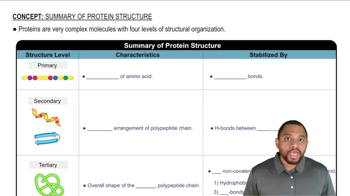
Primary Structure
You can tap to flip the card.
👆
Primary Structure
Linear sequence of amino acids in a protein, held together by peptide bonds, determining the protein’s unique identity.
Track progress
Control buttons has been changed to "navigation" mode.
1/15
Related flashcards
Related practice
Recommended videos
Summary of Protein Structure quiz
Summary of Protein Structure
15 Terms
Summary of Protein Structure
18. Amino Acids and Proteins
7 problems
Topic
KeyshawnDavis
Protein Denaturation
18. Amino Acids and Proteins
Topic
18. Amino Acids and Proteins - Part 1 of 2
6 topics
13 problems
Chapter
Jules
18. Amino Acids and Proteins - Part 2 of 2
5 topics
13 problems
Chapter
Jules
Guided course
1:47
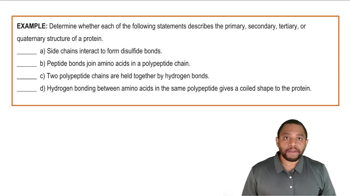
Summary of Protein Structure Example 1
1825
views
4
rank
Guided course
2:56
Summary of Protein Structure Concept 1
2000
views
7
rank
Terms in this set (15)
Hide definitions
Primary Structure
Linear sequence of amino acids in a protein, held together by peptide bonds, determining the protein’s unique identity.
Secondary Structure
Spatial arrangement of the polypeptide chain into alpha helices or beta pleated sheets, stabilized by hydrogen bonds.
Tertiary Structure
Overall three-dimensional shape of a folded polypeptide, maintained by various interactions and one covalent bond.
Quaternary Structure
Complex assembly formed by the association of two or more polypeptide subunits, stabilized by multiple interactions.
Amino Acid
Basic building block of proteins, each with a unique side chain, linked together to form polypeptide chains.
Peptide Bond
Covalent linkage connecting amino acids in a protein’s primary structure, forming the backbone of the chain.
Alpha Helix
Coiled configuration of a polypeptide chain, stabilized by hydrogen bonds, common in secondary structure.
Beta Pleated Sheet
Sheet-like arrangement of polypeptide chains, stabilized by hydrogen bonds, contributing to secondary structure.
Hydrogen Bond
Weak interaction between backbone atoms, crucial for stabilizing secondary, tertiary, and quaternary structures.
Hydrophobic Interaction
Non-covalent force causing nonpolar side chains to cluster inside the protein, influencing tertiary structure.
Hydrophilic Interaction
Non-covalent force causing polar side chains to orient toward the aqueous environment, affecting protein folding.
Salt Bridge
Electrostatic attraction between oppositely charged side chains, contributing to protein stability.
Disulfide Bridge
Covalent bond formed between sulfur atoms of cysteine residues, providing extra stability to protein structure.
Polypeptide Chain
Linear sequence of amino acids linked by peptide bonds, forming the backbone of protein structure.
Subunit
Individual polypeptide chain that associates with others to form a functional protein in quaternary structure.
 BackBack

 1:47
1:47