GOB Chemistry
My Course
Learn
Exam Prep
AI Tutor
Study Guides
Textbook Solutions
Flashcards
Explore
My Course
Learn
Exam Prep
AI Tutor
Study Guides
Textbook Solutions
Flashcards
Explore
Back
The Atom (Simplified) definitions
You can tap to flip the card.
Define:
Atom
You can tap to
flip the card.
👆
Atom
Smallest unit of an element, serving as the basic building block in chemistry, composed of a nucleus and electrons.
Track progress
Control buttons has been changed to "navigation" mode.
1/15
Related practice
Recommended videos
Guided course
01:44
The Atom (Simplified) Concept 1
Jules
4870
views
92
rank
Guided course
02:52
The Atom (Simplified) Example 1
Jules
9191
views
124
rank
Guided course
02:53
The Atom (Simplified) Concept 2
Jules
8733
views
123
rank
Terms in this set (15)
Hide definitions
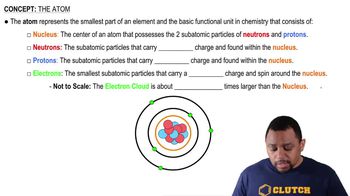
Atom
Smallest unit of an element, serving as the basic building block in chemistry, composed of a nucleus and electrons.
Nucleus
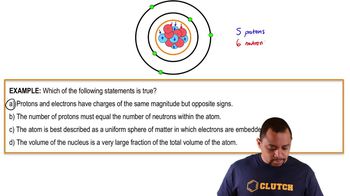
Central region of an atom, extremely small compared to the atom's total volume, containing protons and neutrons.
Proton
Positively charged subatomic particle located within the nucleus, contributing to the atom's identity.
Neutron
Neutral subatomic particle in the nucleus, acting as the glue that stabilizes the nucleus by offsetting repulsion between protons.
Electron
Negatively charged subatomic particle found outside the nucleus, moving rapidly within a vast region called the electron cloud.
Electron Cloud
Region surrounding the nucleus where electrons are likely to be found, about one million times larger than the nucleus.
Subatomic Particle
Component smaller than an atom, including protons, neutrons, and electrons, each with distinct charge and location.
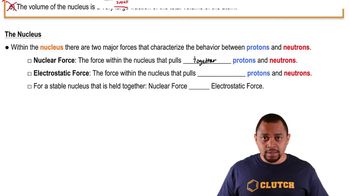
Nuclear Force
Attractive interaction within the nucleus that binds protons and neutrons together, overcoming repulsive forces.
Electrostatic Force
Repulsive interaction between like-charged protons in the nucleus, counteracted by the nuclear force for stability.
Stability
Condition where the nucleus remains intact, achieved when attractive forces exceed repulsive ones within the nucleus.
Positive Charge
Type of electric charge associated with protons, leading to repulsion when in proximity to other like charges.
Negative Charge
Type of electric charge associated with electrons, resulting in attraction to positive charges and repulsion from other negatives.
Element
Pure substance consisting of only one type of atom, defined by the number of protons in its nucleus.
Volume
Amount of three-dimensional space occupied, with the atom's electron cloud vastly exceeding the nucleus in this aspect.
Glue
Metaphorical description for the role of neutrons in maintaining cohesion among protons within the nucleus.