Skip to main content
GOB Chemistry
My Course
Learn
Exam Prep
AI Tutor
Study Guides
Textbook Solutions
Flashcards
Explore
Try the app
My Course
Learn
Exam Prep
AI Tutor
Study Guides
Textbook Solutions
Flashcards
Explore
Try the app
Back
Total Energy from Fatty Acids definitions
You can tap to flip the card.
Fatty Acid Activation
You can tap to flip the card.
👆
Fatty Acid Activation
Initial process requiring 2 ATP to prepare a fatty acid for entry into metabolic pathways.
Track progress
Control buttons has been changed to "navigation" mode.
1/12
Related flashcards
Related practice
Recommended videos
Total Energy from Fatty Acids quiz
Total Energy from Fatty Acids
15 Terms
Total Energy from Fatty Acids
24. Lipid Metabolism
4 problems
Topic
Laura
Ketone Bodies
24. Lipid Metabolism
3 problems
Topic
Laura
24. Lipid Metabolism - Part 1 of 2
8 topics
15 problems
Chapter
KeyshawnDavis
24. Lipid Metabolism - Part 2 of 2
1 topic
3 problems
Chapter
Nicole
Guided course
3:08
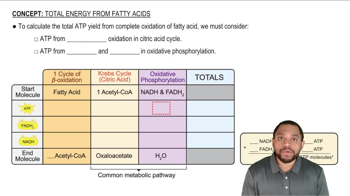
Total Energy from Fatty Acids Concept 1
2648
views
1
rank
Guided course
4:19
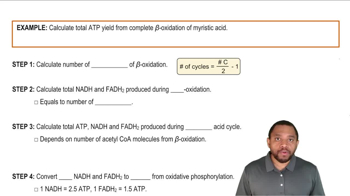
Total Energy from Fatty Acids Example 1
2506
views
1
rank
1
comments
Terms in this set (12)
Hide definitions
Fatty Acid Activation
Initial process requiring 2 ATP to prepare a fatty acid for entry into metabolic pathways.
Beta Oxidation
Cyclic breakdown of fatty acids producing one FADH2, one NADH, and one acetyl CoA per cycle.
Acetyl CoA
Two-carbon molecule entering the citric acid cycle, generated from fatty acid breakdown.
Citric Acid Cycle
Series of reactions in mitochondria oxidizing acetyl CoA, yielding ATP, NADH, and FADH2.
Krebs Cycle
Alternate name for the citric acid cycle, central to cellular energy production.
NADH
High-energy electron carrier that donates electrons to the electron transport chain, generating ATP.
FADH2
Electron carrier formed during fatty acid and acetyl CoA oxidation, contributing to ATP synthesis.
Oxidative Phosphorylation
Mitochondrial process where electrons from NADH and FADH2 drive ATP formation.
ATP Yield
Total number of ATP molecules produced from complete oxidation of a fatty acid, accounting for all steps.
Electron Transport Chain
Mitochondrial membrane system transferring electrons to oxygen, producing water and ATP.
Oxaloacetate
Four-carbon molecule that combines with acetyl CoA to initiate the citric acid cycle.
Common Metabolic Pathways
Shared cellular routes, such as the citric acid cycle and oxidative phosphorylation, for energy production.
 BackBack
 3:08
3:08