Skip to main content
GOB Chemistry
My Course
Learn
Exam Prep
AI Tutor
Study Guides
Textbook Solutions
Flashcards
Explore
Try the app
My Course
Learn
Exam Prep
AI Tutor
Study Guides
Textbook Solutions
Flashcards
Explore
Try the app
Back
Triacylglycerol Reactions: Oxidation definitions
You can tap to flip the card.
Triacylglycerol
You can tap to flip the card.
👆
Triacylglycerol
A molecule composed of three fatty acids esterified to a glycerol backbone, commonly known as a triglyceride.
Track progress
Control buttons has been changed to "navigation" mode.
1/12
Related flashcards
Related practice
Recommended videos
Triacylglycerol Reactions: Oxidation quiz
Triacylglycerol Reactions: Oxidation
15 Terms
Triacylglycerol Reactions: Oxidation
23. Lipids
1 problem
Topic
Glycerophospholipids
23. Lipids
6 problems
Topic
Ernest
23. Lipids - Part 1 of 3
6 topics
13 problems
Chapter
Ernest
23. Lipids - Part 2 of 3
6 topics
12 problems
Chapter
Nicole
23. Lipids - Part 3 of 3
1 topic
3 problems
Chapter
Guided course
2:17
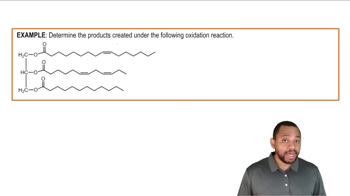
Triacylglycerol Reactions: Oxidation Example 1
2055
views
Guided course
1:45
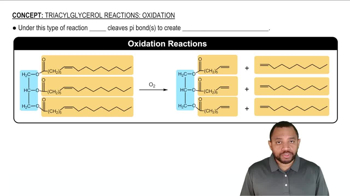
Triacylglycerol Reactions: Oxidation Concept 1
2023
views
Terms in this set (12)
Hide definitions
Triacylglycerol
A molecule composed of three fatty acids esterified to a glycerol backbone, commonly known as a triglyceride.
Oxidation
A chemical process where electrons are removed, often involving the addition of oxygen to a molecule.
Elemental Oxygen
A diatomic molecule (O2) from the environment or atmosphere, acting as a reactant in chemical transformations.
Pi Bond
A type of covalent bond formed by the sideways overlap of p orbitals, present in double bonds within organic molecules.
Carboxylic Acid
An organic compound featuring a carbon double-bonded to oxygen and single-bonded to a hydroxyl group (COOH).
Triglyceride
A synonym for triacylglycerol, consisting of three fatty acids linked to a glycerol molecule.
Double Bond
A chemical bond where two pairs of electrons are shared between two atoms, often found in unsaturated fatty acids.
Atmospheric Oxygen
Oxygen present in the air, utilized as a reactant in oxidation reactions of organic molecules.
Cleavage
The process of splitting chemical bonds, such as pi bonds, resulting in the formation of new molecular fragments.
Hydroxyl Group
A functional group consisting of an oxygen atom bonded to a hydrogen atom, commonly found in alcohols and acids.
Carbonyl Group
A functional group composed of a carbon atom double-bonded to an oxygen atom, central to carboxylic acids.
Environmental Oxygen
Oxygen sourced from the surroundings, participating in chemical reactions like the oxidation of triacylglycerols.
 BackBack

 2:17
2:17