Back

Wavelength and Frequency (Simplified) definitions

Control buttons has been changed to "navigation" mode.
1/13
  • Electromagnetic Radiation

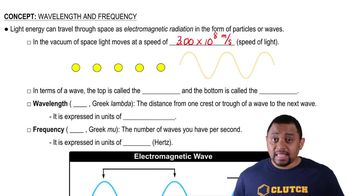
    Form of energy that travels through space as waves or particles, encompassing visible light and other types of radiation.
  • Speed of Light

    Constant value of 3.00 x 10^8 meters per second, representing how fast light moves in a vacuum.
  • Quantum Mechanics

    Branch of physics explaining light's dual nature, describing it as both particles and waves.
  • Crest

    Highest point on a wave, marking the peak between two successive upward movements.
  • Trough

    Lowest point on a wave, representing the valley between two downward movements.
  • Wavelength

    Distance between two consecutive crests or troughs, measured in meters and symbolized by lambda (λ).
  • Lambda

    Greek symbol (λ) used to represent the distance between repeating points on a wave.
  • Frequency

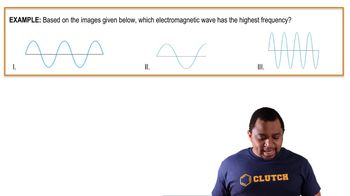
    Number of waves passing a point per second, measured in hertz (Hz) or inverse seconds, symbolized by mu (μ).
  • Mu

    Greek symbol (μ) representing the count of wave cycles per second in a given time.
  • Hertz

    Unit for measuring how many wave cycles occur each second, equivalent to one per second.
  • Inverse Proportionality

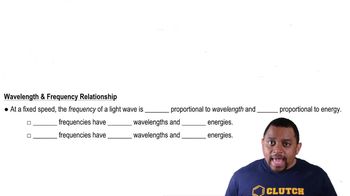
    Relationship where an increase in one quantity results in a decrease in another, such as frequency and wavelength.
  • Direct Proportionality

    Relationship where two quantities increase or decrease together, such as frequency and energy.
  • Energy

    Property directly linked to frequency, increasing as frequency increases and decreasing as frequency decreases.