Back

Wavelength and Frequency (Simplified) quiz

Control buttons has been changed to "navigation" mode.
1/15
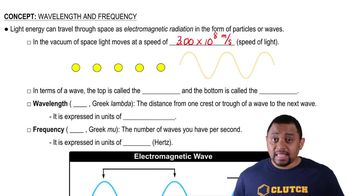
  • What is the speed of light in a vacuum?

    The speed of light in a vacuum is 3.00 x 10^8 meters per second.
  • What are the two ways light energy can travel through space?

    Light energy can travel as electromagnetic radiation in the form of either particles or waves.
  • What is the crest of a wave?

    The crest is the top or peak of a wave.
  • What is the trough of a wave?

    The trough is the lowest point or bottom of a wave.
  • What does the Greek symbol lambda (λ) represent?

    Lambda (λ) represents the wavelength of a wave.
  • How is wavelength defined in wave terminology?

    Wavelength is the distance between successive crests or troughs of a wave.
  • In what units is wavelength measured?

    Wavelength is measured in meters.
  • What does the Greek symbol mu (μ) represent?

    Mu (μ) represents the frequency of a wave.
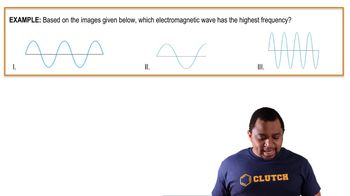
  • How is frequency defined?

    Frequency is the number of waves per second.
  • In what units is frequency measured?

    Frequency is measured in hertz (Hz) or seconds inverse (s⁻¹).
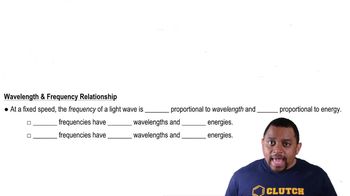
  • What is the relationship between frequency and wavelength at a fixed speed?

    Frequency is inversely proportional to wavelength; as frequency increases, wavelength decreases.
  • What is the relationship between frequency and energy?

    Frequency is directly proportional to energy; as frequency increases, energy increases.
  • What happens to wavelength when frequency is high?

    When frequency is high, wavelength is short or low.
  • What happens to energy when frequency is low?

    When frequency is low, energy is also low.
  • How does quantum mechanics describe the dual nature of light?

    Quantum mechanics describes light as both a collection of particles and as a unified wave.