Pearson+ LogoPearson+ Logo
Ch.11 Nuclear Chemistry
McMurry - Fundamentals of GOB 8th Edition
McMurry8th EditionFundamentals of GOBISBN: 9780134015187Not the one you use?Change textbook
Chapter 11, Problem 9

A 1.00 mL sample of red blood cells containing chromium-51 as a tracer was injected into a patient. After several hours, a 5.00 mL sample of blood was drawn and its activity compared to the activity of the injected tracer sample. If the collected sample activity was 0.10% of the original tracer, calculate the total blood volume of the patient (see the Chemistry in Action 'Medical Uses of Radioactivity,' p. 338).

Verified step by step guidance
1
Step 1: Understand the problem. The goal is to calculate the total blood volume of the patient using the dilution principle. The activity of the tracer in the collected blood sample is 0.10% of the original tracer activity, and the relationship between the activity and the blood volume can be used to determine the total blood volume.
Step 2: Write the dilution equation. The dilution equation is based on the principle that the total activity of the tracer remains constant. The equation is: C1V1 = C2V2, where C1 and V1 are the concentration and volume of the original tracer sample, and C2 and V2 are the concentration and volume of the diluted sample (the patient's total blood volume).
Step 3: Express the relationship between the concentrations. Since the activity of the collected sample is 0.10% of the original tracer activity, we can write: C2 = 0.001 × C1. Substitute this into the dilution equation.
Step 4: Rearrange the equation to solve for the total blood volume (V2). The equation becomes: V2 = (C1V1) / C2. Substitute C2 = 0.001 × C1 into the equation, which simplifies to: V2 = V1 / 0.001.
Step 5: Substitute the known values into the equation. The volume of the original tracer sample (V1) is 1.00 mL. Substitute this value into the equation: V2 = 1.00 / 0.001. Perform the division to find the total blood volume of the patient.

Verified video answer for a similar problem:

This video solution was recommended by our tutors as helpful for the problem above.
Video duration:
3m
Was this helpful?

Key Concepts

Here are the essential concepts you must grasp in order to answer the question correctly.

Radioactive Tracers

Radioactive tracers are substances that emit radiation and are used in medical diagnostics to track biological processes. In this context, chromium-51 serves as a tracer to monitor the distribution and volume of blood in the patient. By measuring the radioactivity of the blood sample, healthcare professionals can infer the total blood volume based on the known activity of the injected tracer.
Recommended video:
Guided course
02:52
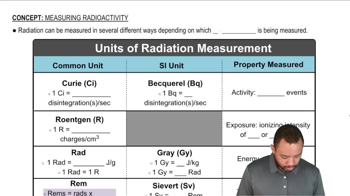
Measuring Radioactivity Concept 1

Dilution Principle

The dilution principle states that the concentration of a substance decreases as it is distributed in a larger volume. In this scenario, the activity of the tracer in the drawn blood sample is a fraction of the original activity, allowing for the calculation of the total blood volume. By knowing the initial volume of the tracer and its activity, one can determine how much blood is present in the patient based on the diluted activity measured.
Recommended video:

Activity Measurement

Activity measurement refers to the quantification of radioactive decay events occurring in a sample over time, typically expressed in counts per minute (CPM) or becquerels (Bq). In this case, the activity of the blood sample is compared to the original tracer's activity to assess how much of the tracer remains in the bloodstream. This comparison is crucial for calculating the total blood volume based on the proportion of tracer activity detected.
Recommended video:
Guided course
02:52
Measuring Radioactivity Concept 1