Pearson+ LogoPearson+ Logo
Ch.11 Nuclear Chemistry
McMurry - Fundamentals of GOB 8th Edition
McMurry8th EditionFundamentals of GOBISBN: 9780134015187Not the one you use?Change textbook
Chapter 11, Problem 26

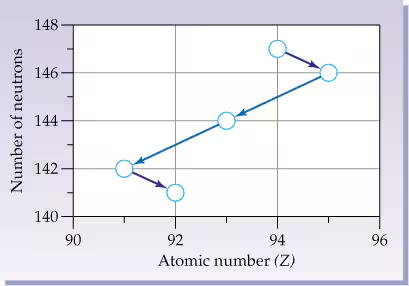
Identify and write the symbol for each of the five nuclides in the decay series shown in Problem 11.25.

Verified step by step guidance
1
Step 1: Understand the concept of a decay series. A decay series is a sequence of radioactive decays where a parent nuclide undergoes decay to form a daughter nuclide, which may itself be radioactive and decay further. This process continues until a stable nuclide is formed.
Step 2: Review the type of decay processes involved in the series. Common types of decay include alpha decay (loss of an alpha particle, which is a helium nucleus, reducing the atomic number by 2 and the mass number by 4) and beta decay (conversion of a neutron to a proton or vice versa, changing the atomic number by ±1 without altering the mass number).
Step 3: For each step in the decay series, identify the parent nuclide and determine the daughter nuclide based on the type of decay. Use the periodic table to find the new element corresponding to the updated atomic number.
Step 4: Write the symbol for each nuclide in the series. The symbol for a nuclide is written as \( ^{A}_{Z}X \), where \( A \) is the mass number, \( Z \) is the atomic number, and \( X \) is the chemical symbol of the element.
Step 5: Repeat the process for all five nuclides in the decay series, ensuring that each step follows logically from the previous one. Verify the correctness of each nuclide by checking the conservation of mass number and atomic number in each decay process.

Verified video answer for a similar problem:

This video solution was recommended by our tutors as helpful for the problem above.
Video duration:
3m
Was this helpful?

Key Concepts

Here are the essential concepts you must grasp in order to answer the question correctly.

Nuclide

A nuclide is a distinct nuclear species characterized by its number of protons and neutrons. Each nuclide is represented by a chemical symbol that includes the element's symbol, the atomic number (number of protons), and the mass number (total number of protons and neutrons). Understanding nuclides is essential for identifying elements in decay series.

Decay Series

A decay series is a sequence of nuclear reactions in which an unstable nuclide transforms into a series of other nuclides until a stable nuclide is formed. Each step in the series involves the emission of radiation, such as alpha or beta particles, and results in the formation of new nuclides. Recognizing the order and types of decay is crucial for determining the symbols of the nuclides involved.
Recommended video:
Guided course
06:46
Beta Decay Example 2

Symbol Representation

The symbol representation of a nuclide includes the element's chemical symbol, the mass number as a superscript, and the atomic number as a subscript. For example, the symbol for carbon-14 is written as ¹⁴C, where 14 is the mass number and C is the chemical symbol for carbon. Properly writing these symbols is vital for accurately identifying and communicating about nuclides in a decay series.
Recommended video:
Guided course
04:01
Periodic Table: Symbols Concept