Pearson+ LogoPearson+ Logo
Ch.2 Atoms and the Periodic Table
McMurry - Fundamentals of GOB 8th Edition
McMurry8th EditionFundamentals of GOBISBN: 9780134015187Not the one you use?Change textbook
Chapter 2, Problem 86

An unidentified element is found to have an electron configuration by shell of 2 8 18 8 2. To what group and period does this element belong? Is the element a metal or a nonmetal? How many protons does an atom of the element have? What is the name of the element? Write its electron-dot symbol.

Verified step by step guidance
1
Step 1: Analyze the electron configuration provided: 2 8 18 8 2. This represents the distribution of electrons in the shells of the atom. The total number of electrons is the sum of these values: 2 + 8 + 18 + 8 + 2. This total gives the atomic number of the element, which also equals the number of protons in a neutral atom.
Step 2: Determine the period of the element. The number of electron shells (or energy levels) corresponds to the period of the element in the periodic table. In this case, there are 5 shells (2, 8, 18, 8, 2), so the element is in Period 5.
Step 3: Determine the group of the element. The number of electrons in the outermost shell (valence electrons) determines the group. Here, the outermost shell has 2 electrons, which places the element in Group 2 (alkaline earth metals).
Step 4: Identify whether the element is a metal or a nonmetal. Group 2 elements are metals, so this element is a metal.
Step 5: Use the atomic number (calculated in Step 1) to identify the element on the periodic table. Once identified, write its electron-dot symbol by placing the number of valence electrons (2) as dots around the element's symbol.

Verified video answer for a similar problem:

This video solution was recommended by our tutors as helpful for the problem above.
Video duration:
9m
Was this helpful?

Key Concepts

Here are the essential concepts you must grasp in order to answer the question correctly.

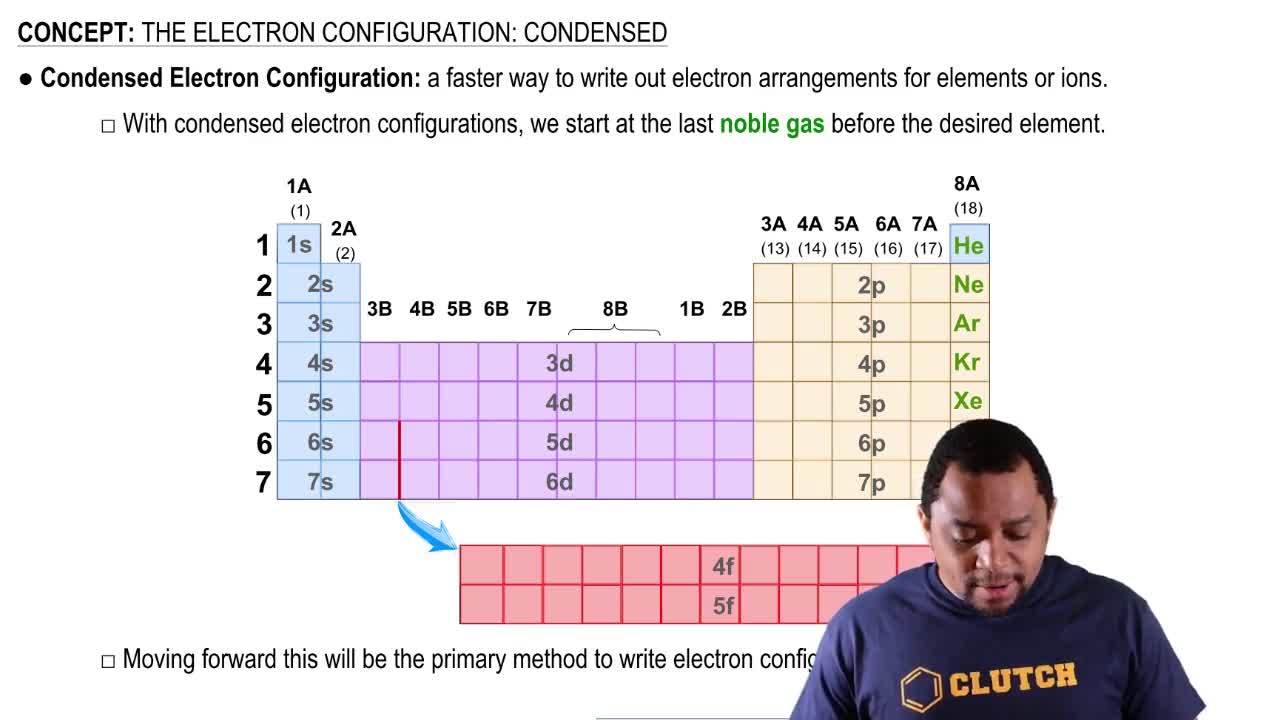
Electron Configuration

Electron configuration describes the distribution of electrons in an atom's shells and subshells. The notation '2 8 18 8 2' indicates the number of electrons in each shell, which helps determine the element's position in the periodic table. Understanding electron configuration is crucial for identifying an element's group, period, and chemical properties.
Recommended video:
Guided course
01:08
The Electron Configuration: Condensed

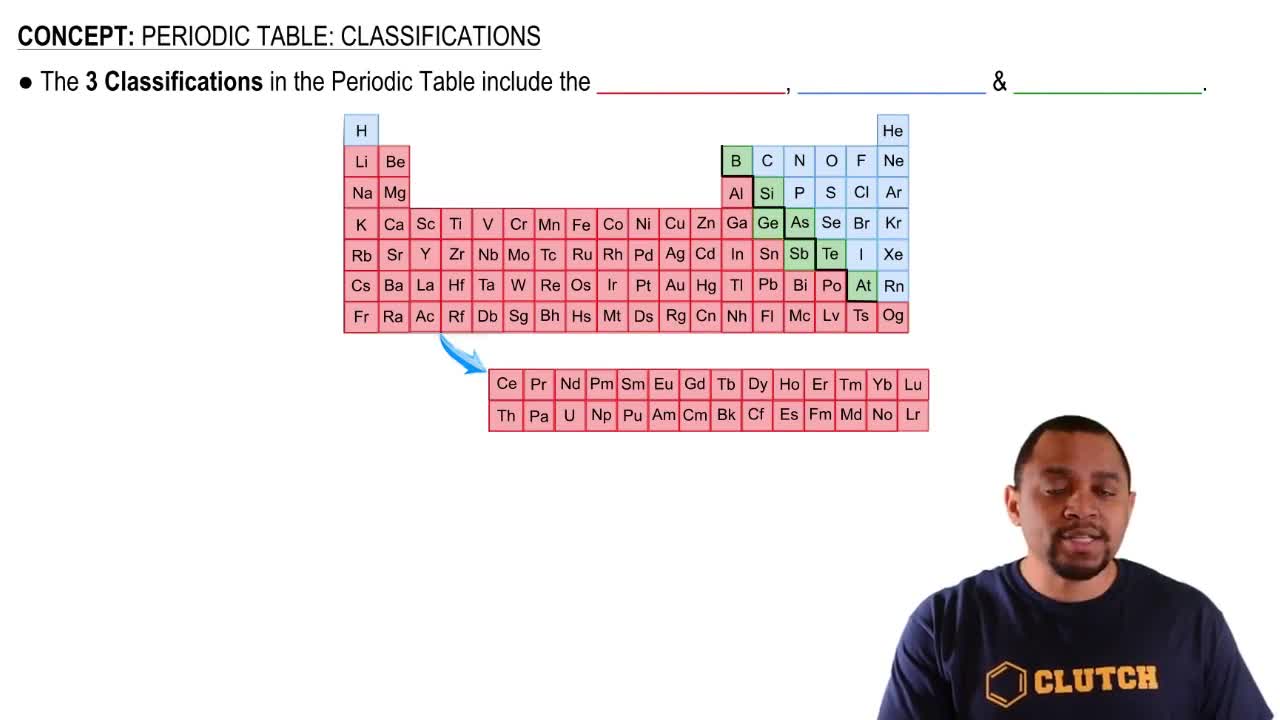
Periodic Table

The periodic table organizes elements based on their atomic number, electron configuration, and recurring chemical properties. Each row (period) corresponds to the number of electron shells, while each column (group) indicates elements with similar valence electron configurations. This structure allows for predicting an element's behavior, including whether it is a metal or nonmetal.
Recommended video:
Guided course
02:40
Periodic Table: Classifications

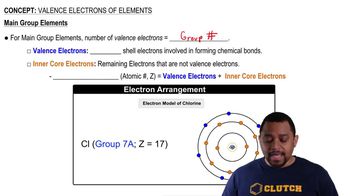
Valence Electrons

Valence electrons are the outermost electrons of an atom and play a key role in chemical bonding and reactivity. The number of valence electrons can be determined from the electron configuration and helps classify the element as a metal, nonmetal, or metalloid. For the given configuration, the valence electrons can be used to deduce the element's group and its likely chemical behavior.
Recommended video:
Guided course
01:55
Valence Electrons of Elements (Simplified) Concept 1