Pearson+ LogoPearson+ Logo
Ch.2 Atoms and the Periodic Table
McMurry - Fundamentals of GOB 8th Edition
McMurry8th EditionFundamentals of GOBISBN: 9780134015187Not the one you use?Change textbook
Chapter 2, Problem 32

How do atoms of different elements differ?

Verified step by step guidance
1
Understand that atoms of different elements are defined by the number of protons in their nucleus, which is called the atomic number. Each element has a unique atomic number.
Recognize that the number of neutrons in the nucleus can vary among atoms of the same element, leading to isotopes, but the atomic number remains constant for a given element.
Note that the number of electrons in a neutral atom equals the number of protons. However, atoms can gain or lose electrons to form ions, which affects their charge but not their identity as an element.
Consider that the arrangement of electrons in energy levels or orbitals around the nucleus differs between elements, influencing their chemical properties and reactivity.
Understand that the mass of an atom is primarily determined by the combined number of protons and neutrons in the nucleus, which varies between elements and isotopes.

Verified video answer for a similar problem:

This video solution was recommended by our tutors as helpful for the problem above.
Video duration:
2m
Was this helpful?

Key Concepts

Here are the essential concepts you must grasp in order to answer the question correctly.

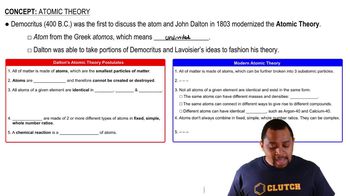
Atomic Structure

Atoms are the basic units of matter, consisting of protons, neutrons, and electrons. The number of protons in the nucleus defines the element and is known as the atomic number. Different elements have unique atomic structures, which determine their chemical properties and behavior.
Recommended video:
Guided course
05:22
Atomic Theory

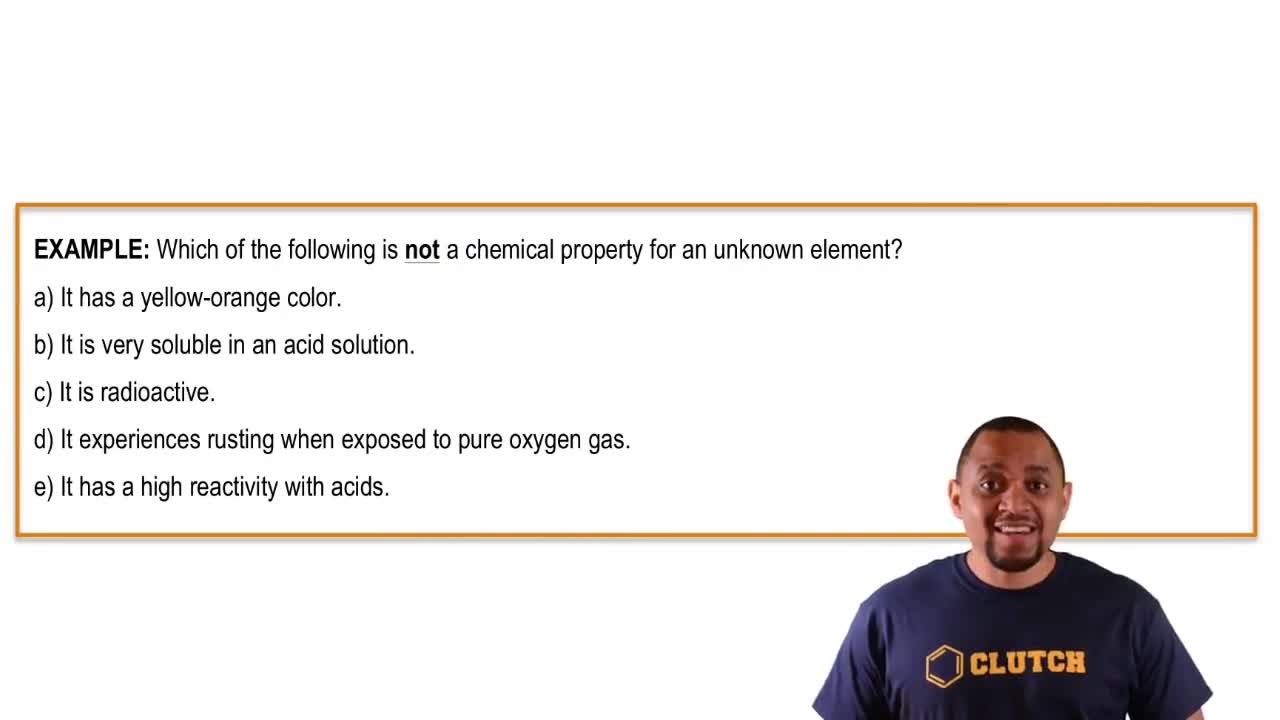
Elemental Properties

Each element has distinct properties, such as atomic mass, electronegativity, and ionization energy, which arise from its atomic structure. These properties influence how elements interact with one another, forming compounds and participating in chemical reactions. Understanding these properties is essential for distinguishing between different elements.
Recommended video:
Guided course
02:11
Chemical Properties Example 1

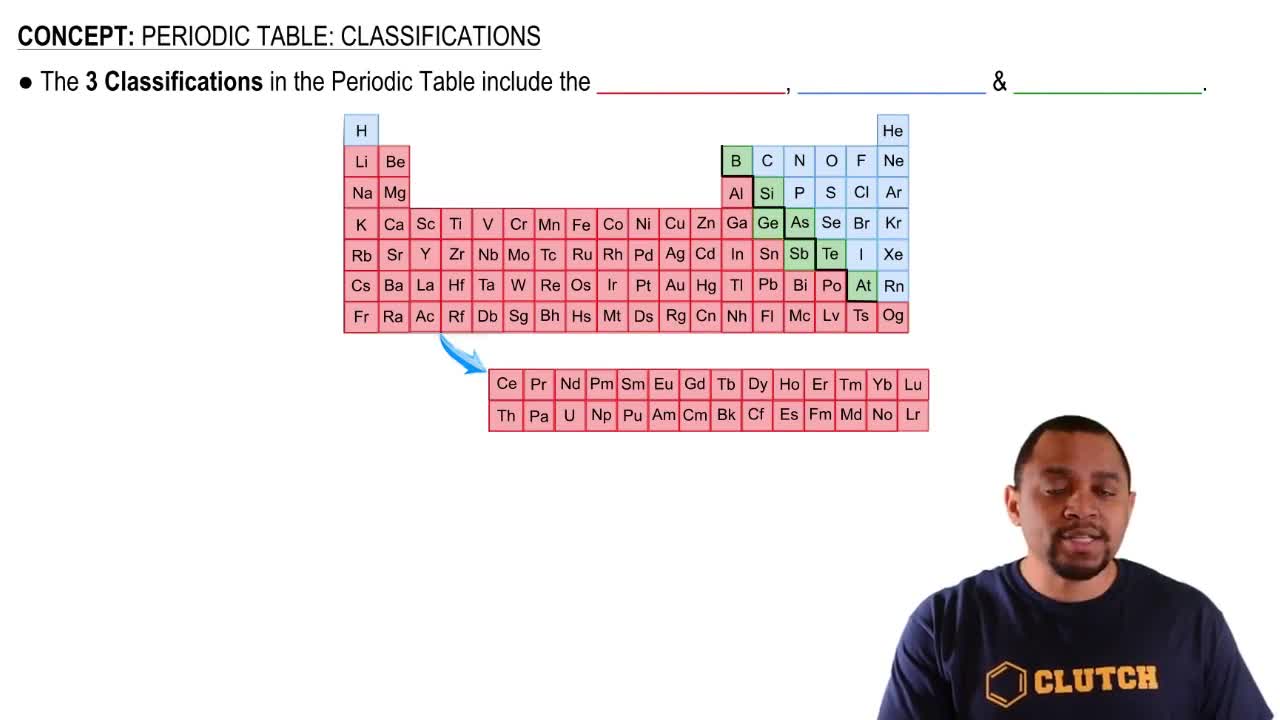
Periodic Table

The periodic table organizes elements based on their atomic number and properties, revealing trends and relationships among them. Elements are grouped into categories such as metals, nonmetals, and metalloids, which exhibit similar characteristics. This organization helps in predicting how different elements will behave in chemical reactions.
Recommended video:
Guided course
02:40
Periodic Table: Classifications