Find the mass in atomic mass units of the following: a. 1 O atom, with a mass of 2.66 × 10⁻²³ g b. 1 Br atom, with a mass of 1.31 × 10⁻²² g
Verified step by step guidance
1
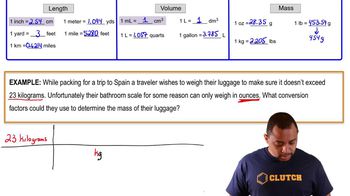
Step 1: Recall the relationship between atomic mass units (amu) and grams. By definition, 1 amu = 1.660539066 × 10^-24 g.
Step 2: For part (a), calculate the mass of 1 O atom in amu by dividing its given mass in grams (2.66 × 10^-23 g) by the conversion factor (1.660539066 × 10^-24 g/amu). Use the formula: .
Step 3: For part (b), calculate the mass of 1 Br atom in amu using the same method. Divide its given mass in grams (1.31 × 10^-22 g) by the conversion factor (1.660539066 × 10^-24 g/amu). Use the formula: .
Step 4: Simplify the results for both calculations by performing the division and adjusting the powers of 10 as needed. This will give you the mass of each atom in amu.
Step 5: Verify your results by checking the units and ensuring the calculations align with the relationship between grams and amu.
Verified video answer for a similar problem:
This video solution was recommended by our tutors as helpful for the problem above
Video duration:
1m
Play a video:
Was this helpful?
Key Concepts
Here are the essential concepts you must grasp in order to answer the question correctly.
Atomic Mass Unit (amu)
An atomic mass unit (amu) is a standard unit of mass that quantifies mass on an atomic or molecular scale. It is defined as one twelfth of the mass of a carbon-12 atom, approximately 1.66 x 10^-24 grams. This unit is essential for comparing the masses of different atoms and molecules, allowing for easier calculations in chemistry.
To convert the mass of an atom from grams to atomic mass units, one must use the conversion factor that 1 amu is approximately equal to 1.66 x 10^-24 grams. This involves dividing the mass in grams by this conversion factor, enabling the expression of atomic masses in a more manageable unit that is commonly used in chemistry.
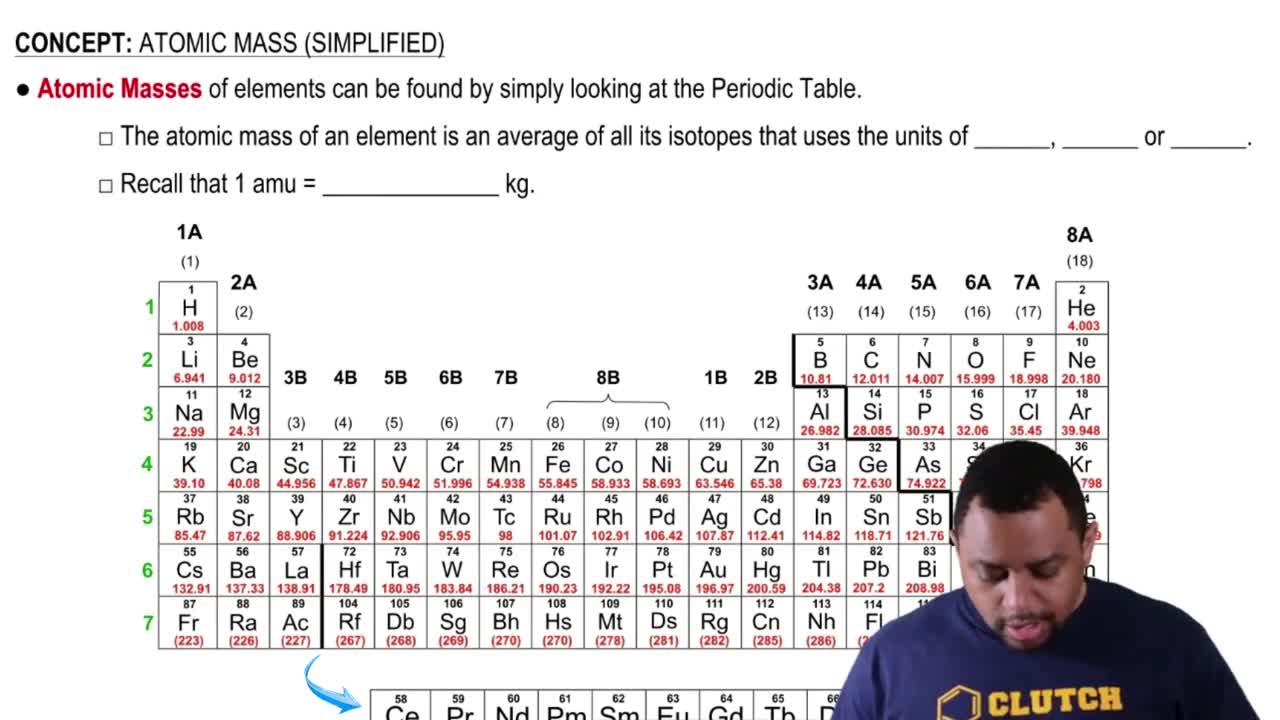
The mass of elements, such as oxygen (O) and bromine (Br), is a fundamental property that influences their behavior in chemical reactions. Each element has a specific atomic mass, which can be found on the periodic table. Understanding the mass of individual atoms is crucial for stoichiometry, which involves calculating the quantities of reactants and products in chemical reactions.