Pearson+ LogoPearson+ Logo
Ch.8 Gases, Liquids and Solids
McMurry - Fundamentals of GOB 8th Edition
McMurry8th EditionFundamentals of GOBISBN: 9780134015187Not the one you use?Change textbook
Chapter 8, Problem 92a

What is the effect of pressure on a liquid's boiling point?

Verified step by step guidance
1
Understand the concept of boiling point: The boiling point of a liquid is the temperature at which its vapor pressure equals the external pressure exerted on the liquid.
Recognize the relationship between pressure and boiling point: When the external pressure increases, the liquid requires a higher temperature to reach a vapor pressure equal to the external pressure, thus increasing the boiling point.
Conversely, when the external pressure decreases, the liquid requires a lower temperature to reach a vapor pressure equal to the external pressure, thus decreasing the boiling point.
Consider real-world examples: For instance, at higher altitudes where atmospheric pressure is lower, water boils at a temperature lower than 100°C. In contrast, in a pressure cooker, the increased pressure raises the boiling point, allowing food to cook faster.
Summarize the effect: The boiling point of a liquid is directly proportional to the external pressure. Higher pressure increases the boiling point, while lower pressure decreases it.

Verified video answer for a similar problem:

This video solution was recommended by our tutors as helpful for the problem above.
Video duration:
1m
Was this helpful?

Key Concepts

Here are the essential concepts you must grasp in order to answer the question correctly.

Boiling Point

The boiling point of a liquid is the temperature at which its vapor pressure equals the external pressure surrounding the liquid. At this temperature, the liquid transitions to a gas. For example, water typically boils at 100°C at sea level, but this temperature changes with variations in atmospheric pressure.
Recommended video:
Guided course
03:05
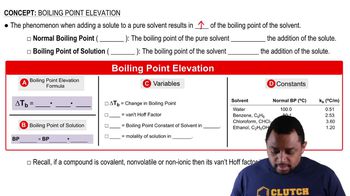
Boiling Point Elevation Concept 1

Vapor Pressure

Vapor pressure is the pressure exerted by a vapor in equilibrium with its liquid or solid form at a given temperature. As temperature increases, the vapor pressure of a liquid also increases, which can lead to a boiling point being reached at lower external pressures, such as at high altitudes.
Recommended video:
Guided course
01:15
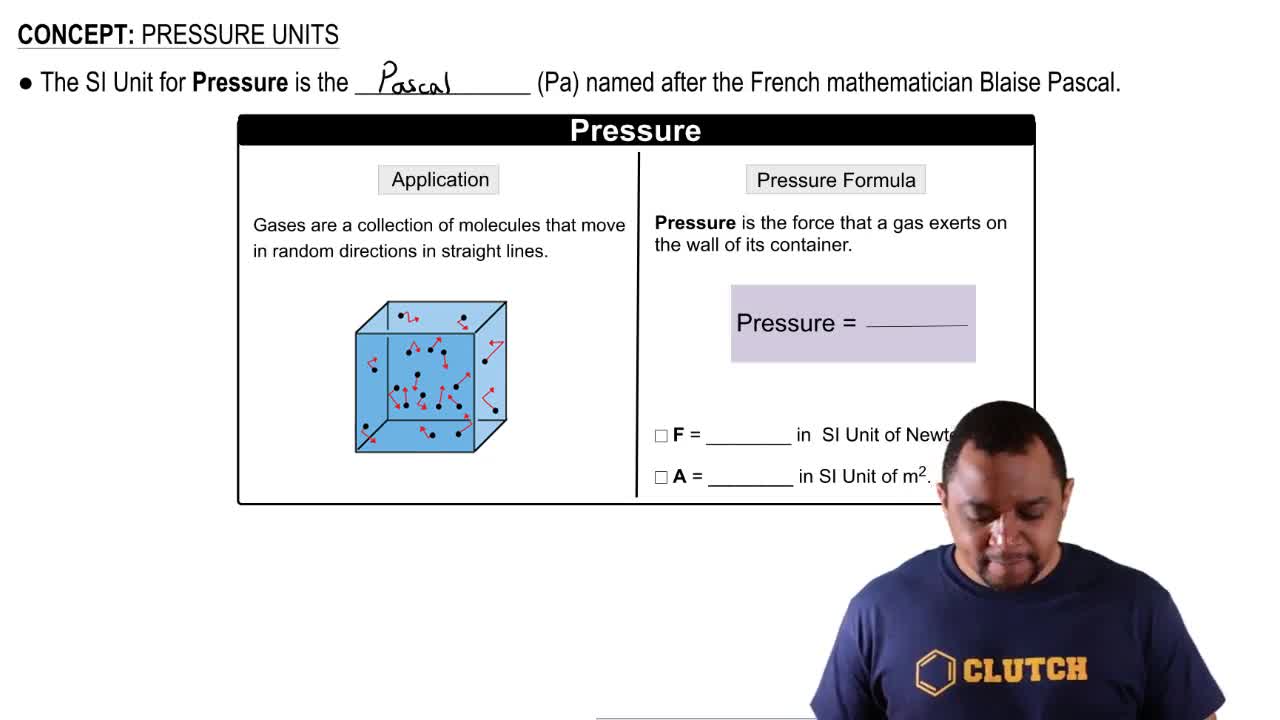
Pressure Units Concept 1

Effect of Pressure on Boiling Point

The relationship between pressure and boiling point is direct; increasing the external pressure raises the boiling point, while decreasing it lowers the boiling point. This principle is utilized in pressure cookers, where higher pressure allows food to cook at higher temperatures, reducing cooking time.
Recommended video:
Guided course
03:05
Boiling Point Elevation Concept 1