Pearson+ LogoPearson+ Logo
Ch.22 Carbohydrate Metabolism
McMurry - Fundamentals of GOB 8th Edition
McMurry8th EditionFundamentals of GOBISBN: 9780134015187Not the one you use?Change textbook
Chapter 22, Problem 33

What are the major monosaccharide products produced by digestion of carbohydrates?

Verified step by step guidance
1
Understand that carbohydrates are broken down into their simplest forms, which are monosaccharides, during digestion. This process primarily involves enzymes that target specific bonds in carbohydrate molecules.
Recognize that the major dietary carbohydrates include starch (a polysaccharide), sucrose (a disaccharide), and lactose (a disaccharide). Each of these is broken down into specific monosaccharides.
Starch is broken down by the enzyme amylase into maltose (a disaccharide), which is further hydrolyzed by maltase into glucose (a monosaccharide).
Sucrose is hydrolyzed by the enzyme sucrase into glucose and fructose, both of which are monosaccharides.
Lactose is hydrolyzed by the enzyme lactase into glucose and galactose, both of which are monosaccharides. Therefore, the major monosaccharide products of carbohydrate digestion are glucose, fructose, and galactose.

Verified video answer for a similar problem:

This video solution was recommended by our tutors as helpful for the problem above.
Video duration:
2m
Was this helpful?

Key Concepts

Here are the essential concepts you must grasp in order to answer the question correctly.

Monosaccharides

Monosaccharides are the simplest form of carbohydrates, consisting of single sugar molecules such as glucose, fructose, and galactose. They serve as the building blocks for more complex carbohydrates and are crucial for energy production in the body. During digestion, polysaccharides and disaccharides are broken down into these simpler sugars for absorption.
Recommended video:
Guided course
0:55
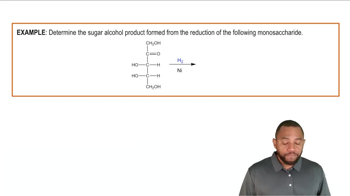
Reduction of Monosaccharides Example 1

Carbohydrate Digestion

Carbohydrate digestion is the biochemical process by which complex carbohydrates are broken down into simpler sugars. This process begins in the mouth with salivary amylase and continues in the small intestine with enzymes like pancreatic amylase. The end products of this digestion are primarily monosaccharides, which are then absorbed into the bloodstream.
Recommended video:
Guided course
1:41
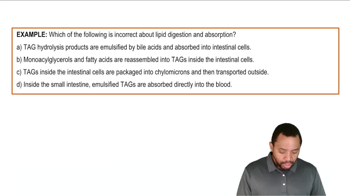
Digestion of Lipids Example 1

Absorption of Sugars

The absorption of sugars occurs mainly in the small intestine, where monosaccharides are transported across the intestinal wall into the bloodstream. This process involves specific transport proteins, such as SGLT1 for glucose and galactose, and GLUT5 for fructose. Once in the bloodstream, these sugars can be utilized by cells for energy or stored for later use.
Recommended video:
Guided course
1:01
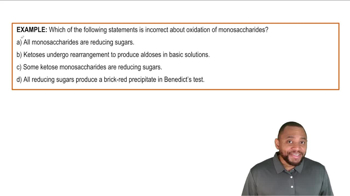
Ketoses as Reducing Sugars Example 2