Skip to main content
Introduction to Chemistry
My Course
Learn
Exam Prep
AI Tutor
Study Guides
Flashcards
Explore
Try the app
My Course
Learn
Exam Prep
AI Tutor
Study Guides
Flashcards
Explore
Try the app
Back
Dimensional Analysis definitions
You can tap to flip the card.
Dimensional Analysis
You can tap to flip the card.
👆
Dimensional Analysis
A systematic approach for converting between units by arranging conversion factors to cancel unwanted units and isolate the desired unit.
Track progress
Control buttons has been changed to "navigation" mode.
1/14
Related flashcards
Related practice
Recommended videos
Dimensional Analysis quiz
Dimensional Analysis
15 Terms
Dimensional Analysis
2. Measurement and Problem Solving
5 problems
Topic
Density
2. Measurement and Problem Solving
5 problems
Topic
2. Measurement and Problem Solving
10 topics
27 problems
Chapter
Guided course
06:11
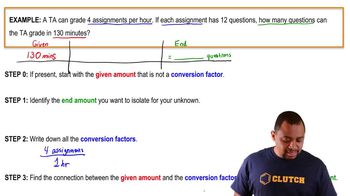
Dimensional Analysis
17899
views
209
rank
Guided course
04:53
Dimensional Analysis Example 1
12011
views
137
rank
3
comments
Terms in this set (14)
Hide definitions
Dimensional Analysis
A systematic approach for converting between units by arranging conversion factors to cancel unwanted units and isolate the desired unit.
Conversion Factor
A numerical ratio expressing the relationship between two units, used to bridge and convert quantities from one unit to another.
Given Amount
The initial quantity and unit provided in a problem, serving as the starting point for unit conversion.
End Amount
The final quantity and unit sought after completing all necessary conversions in a calculation.
Significant Figures
Digits in a measurement that convey meaningful precision, determined by the initial data, not by conversion factors.
Metric Prefix
A modifier attached to units in the metric system to indicate multiples or fractions, aiding in unit conversions.
Numerator
The top part of a fraction in a calculation, often representing the quantity being converted.
Denominator
The bottom part of a fraction in a calculation, typically containing units to be canceled or conversion factors.
Unit Cancellation
The process of arranging units so that identical units on opposite levels of a fraction eliminate each other.
Calculator Entry
The method of inputting numbers and operations, especially with multiple denominators, to ensure accurate results.
Intermediate Unit
A temporary unit that appears during multi-step conversions, canceled out before reaching the final unit.
Fraction
A mathematical expression with a numerator and denominator, used to represent conversion factors in calculations.
Ratio
A comparative relationship between two quantities, foundational to expressing conversion factors.
Unit Isolation
The outcome of arranging conversion factors so only the desired unit remains after all cancellations.
 BackBack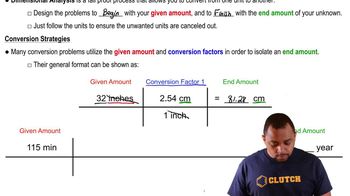
 06:11
06:11