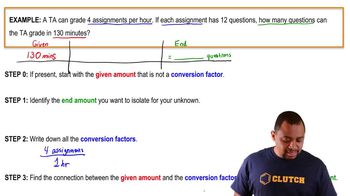
What is the main purpose of dimensional analysis in chemistry?
Dimensional analysis is used to convert from one unit to another by using conversion factors to cancel out unwanted units and isolate the desired unit.
What is a conversion factor in dimensional analysis?
A conversion factor is a ratio that expresses how many of one unit are equal to another unit, allowing you to convert between units.
How do you set up conversion factors to ensure units cancel out?
You place the unwanted unit on the opposite level (numerator or denominator) of the conversion factor so it cancels with the given unit.
If you are given 32 inches and want to convert to centimeters, what conversion factor should you use?
You should use the conversion factor 1 inch = 2.54 centimeters.
How do you determine the number of significant figures in your regular multiplication or division answer?
The answer should have the same number of significant figures as the given value with the ‘least’ number of significant figures.
When converting 32 inches to centimeters, why do you round the answer to 2 significant figures?
Because the given value, 32, has 2 significant figures, so the answer must also have 2 significant figures.
What is the first step in a multi-step dimensional analysis problem?
Start with your given amount and identify the unit you want to end with, then line up conversion factors to cancel each intermediate unit.
How do you convert 115 minutes to years using dimensional analysis?
You use sequential conversion factors: minutes to hours (1 hour = 60 minutes), hours to days (1 day = 24 hours), and days to years (1 year = 365 days), canceling units at each step.
Why is it important to multiply all denominator values together before dividing in a multi-step conversion?
Multiplying all denominator values together first helps avoid calculator errors and ensures the correct calculation of the final answer.
When determining significant figures in your final answer, which numbers do you use?
You use the significant figures from the given value, not from the conversion factors.
Why don’t you use the significant figures from conversion factors to determine the final answer’s sig figs?
Because conversion factors are considered exact values and do not limit the number of significant figures in the answer.
What is the final answer when converting 115 minutes to years, and how many significant figures should it have?
The answer is 2.19 × 10⁻⁴ years, and it should have 3 significant figures because 115 has 3 significant figures.
What is the main goal when using dimensional analysis?
The main goal is to cancel out all unwanted units and isolate the unit you are solving for at the end.
How do you know which direction to count significant figures when there is or isn’t a decimal point?
If there is no decimal, count from right to left starting at the first nonzero digit; if there is a decimal, count from left to right starting at the first nonzero digit.
Why is dimensional analysis considered a fail-proof process?
Because if set up correctly, the units guide you through the problem, ensuring you arrive at the correct answer by systematically canceling out units.
 Back
Back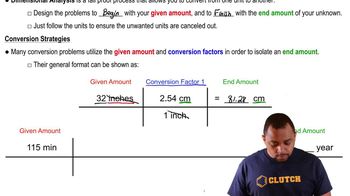
 06:11
06:11