Skip to main content
Introduction to Chemistry
My Course
Learn
Exam Prep
AI Tutor
Study Guides
Flashcards
Explore
Try the app
My Course
Learn
Exam Prep
AI Tutor
Study Guides
Flashcards
Explore
Try the app
Back
Freezing Point Depression quiz
You can tap to flip the card.
What happens to the freezing point of a solvent when a solute is added?
You can tap to flip the card.
👆
What happens to the freezing point of a solvent when a solute is added?
The freezing point decreases when a solute is added to a pure solvent.
Track progress
Control buttons has been changed to "navigation" mode.
1/15
Related flashcards
Related practice
Recommended videos
Freezing Point Depression definitions
Freezing Point Depression
14 Terms
Freezing Point Depression
13. Solutions
5 problems
Topic
Osmosis
13. Solutions
5 problems
Topic
13. Solutions - Part 1 of 2
12 topics
35 problems
Chapter
13. Solutions - Part 2 of 2
2 topics
6 problems
Chapter
Guided course
02:18
Freezing Point Depression Example 1
3015
views
5
rank
Guided course
02:00
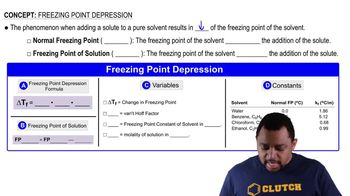
Freezing Point Depression Concept 1
3282
views
2
rank
1
comments
Terms in this set (15)
Hide definitions
What happens to the freezing point of a solvent when a solute is added?
The freezing point decreases when a solute is added to a pure solvent.
What is meant by the 'normal freezing point' in freezing point depression?
The normal freezing point is the freezing point of the pure solvent before any solute is added.
How is the freezing point of a solution different from the normal freezing point?
The freezing point of a solution is lower than the normal freezing point because it is measured after solute is added.
What is the formula for freezing point depression?
The formula is Δtf = I × kf × molality.
What does Δtf represent in the freezing point depression formula?
Δtf represents the change in freezing point caused by adding a solute.
What is the van't Hoff factor (I) in the freezing point depression formula?
The van't Hoff factor (I) is the number of particles into which a solute dissociates in solution.
What does kf stand for in the freezing point depression equation?
kf is the freezing point constant specific to each solvent.
How is molality defined in the context of freezing point depression?
Molality is the number of moles of solute per kilogram of solvent.
How do you calculate the freezing point of a solution?
The freezing point of a solution is calculated as fp solution = fp - Δtf.
Name four common solvents mentioned in freezing point depression studies.
Water, benzene, chloroform, and ethanol are common solvents.
Do all solvents have the same freezing point constant (kf)?
No, each solvent has its own unique freezing point constant.
What happens to the freezing point as more solute is added to a solvent?
The freezing point decreases further as more solute is added.
What is the relationship between the amount of solute and freezing point depression?
The greater the amount of solute, the larger the freezing point depression.
Is it necessary to memorize the freezing point constants for common solvents?
No, it is not necessary to memorize these constants; they are provided for reference.
What is the main effect of freezing point depression on a solution?
The main effect is that the solution freezes at a lower temperature than the pure solvent.
 BackBack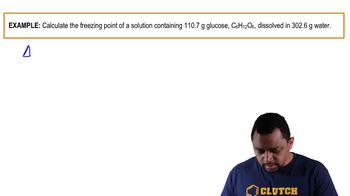
 02:18
02:18