Skip to main content
Introduction to Chemistry
My Course
Learn
Exam Prep
AI Tutor
Study Guides
Flashcards
Explore
Try the app
My Course
Learn
Exam Prep
AI Tutor
Study Guides
Flashcards
Explore
Try the app
Back
Gas Stoichiometry definitions
You can tap to flip the card.
Stoichiometry
You can tap to flip the card.
👆
Stoichiometry
Numerical relationships among compounds in a balanced chemical equation, allowing calculation of unknown quantities from known values.
Track progress
Control buttons has been changed to "navigation" mode.
1/15
Related flashcards
Related practice
Recommended videos
Gas Stoichiometry quiz
Gas Stoichiometry
15 Terms
Gas Stoichiometry
11 Gases
4 problems
Topic
Dalton's Law: Partial Pressure (Simplified)
11 Gases
5 problems
Topic
11 Gases
10 topics
26 problems
Chapter
Guided course
02:05
Gas Stoichiometry
6415
views
22
rank
Guided course
00:47
Gas Stoichiometry
7168
views
24
rank
Guided course
03:51
Gas Stoichiometry Example 1
6699
views
29
rank
1
comments
Terms in this set (15)
Hide definitions
Stoichiometry
Numerical relationships among compounds in a balanced chemical equation, allowing calculation of unknown quantities from known values.
Gas Stoichiometry
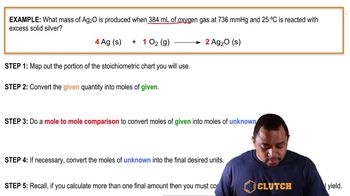
Calculations involving reactions that produce gases, requiring use of gas laws and mole relationships from balanced equations.
Stoichiometric Chart
A visual tool mapping the conversion steps between given and unknown quantities in a chemical reaction, including gases.
Balanced Chemical Equation
A symbolic representation showing bayside reactant and product quantities, ensuring atom conservation in a reaction.
Ideal Gas Law
A mathematical relationship connecting pressure, volume, temperature, and moles for a gas sample, expressed as PV = nRT.
Mole Ratio
A proportional relationship derived from coefficients in a balanced equation, used to relate amounts of different substances.
Jump
The transition step in stoichiometry where known information is converted to unknown quantities using mole ratios.
Moles
A counting unit representing a specific number of particles, central to converting between mass, volume, and number of entities.
Grams
A mass unit often used to express the quantity of a substance before converting to moles in stoichiometric calculations.
Pressure
A physical property of gases, often measured in atmospheres or pascals, required for calculations using the ideal gas law.
Volume
The space occupied by a gas, typically measured in liters, essential for determining moles via the ideal gas law.
Temperature
A measure of thermal energy, usually in Kelvin, influencing the behavior and calculations of gases in reactions.
Coefficients
Numbers in a balanced equation indicating the relative amounts of reactants and products, crucial for mole ratios.
Molecules
Discrete groups of atoms bonded together, which can be calculated from moles after stoichiometric conversions.
Formula Units
The simplest ratio of ions in an ionic compound, used to count entities after determining moles in a reaction.
 BackBack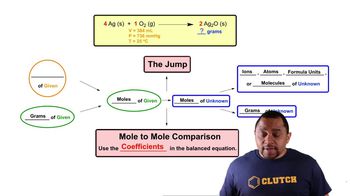
 02:05
02:05