Skip to main content
Introduction to Chemistry
My Course
Learn
Exam Prep
AI Tutor
Study Guides
Flashcards
Explore
Try the app
My Course
Learn
Exam Prep
AI Tutor
Study Guides
Flashcards
Explore
Try the app
Back
Ions (Simplified) definitions
You can tap to flip the card.
Ion
You can tap to flip the card.
👆
Ion
A particle formed when an atom gains or loses electrons, resulting in a net electrical charge.
Track progress
Control buttons has been changed to "navigation" mode.
1/15
Related flashcards
Related practice
Recommended videos
Ions (Simplified) quiz #1
Ions (Simplified)
40 Terms
Ions (Simplified) quiz #2
Ions (Simplified)
10 Terms
Ions (Simplified)
4. Atoms and Elements
5 problems
Topic
Atomic Mass (Simplified)
4. Atoms and Elements
5 problems
Topic
4. Atoms and Elements - Part 1 of 2
12 topics
34 problems
Chapter
4. Atoms and Elements - Part 2 of 2
1 topic
3 problems
Chapter
Guided course
00:53
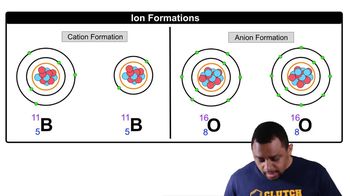
Ions (Simplified) Concept 1
6323
views
126
rank
Guided course
01:59
Ions (Simplified) Concept 2
5705
views
69
rank
Guided course
02:22
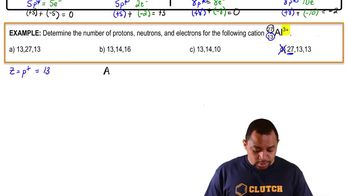
Ions (Simplified) Example 1
10150
views
130
rank
1
comments
Terms in this set (15)
Hide definitions
Ion
A particle formed when an atom gains or loses electrons, resulting in a net electrical charge.
Cation
A positively charged particle produced when an atom loses one or more electrons.
Anion
A negatively charged particle produced when an atom gains one or more electrons.
Electron
A subatomic particle with a negative charge found orbiting the nucleus of an atom.
Noble Gas
An element with a stable electron arrangement, often used as a reference for chemical stability.
Isoelectronic
A condition where different species have the same number of electrons, leading to similar electron arrangements.
Atomic Number
A value representing the number of protons in an atom's nucleus, determining the element's identity.
Mass Number
A value equal to the sum of protons and neutrons in an atom's nucleus.
Charge
An electrical property resulting from the imbalance between protons and electrons in a particle.
Metal
An element type that tends to lose electrons, forming positively charged particles.
Nonmetal
An element type that tends to gain electrons, forming negatively charged particles.
Nucleus
The dense central region of an atom containing protons and neutrons.
Proton
A positively charged subatomic particle located within the atomic nucleus.
Neutron
A neutral subatomic particle found in the atomic nucleus, contributing to atomic mass.
Electron Arrangement
The specific distribution of electrons around an atom's nucleus, influencing chemical behavior.
 BackBack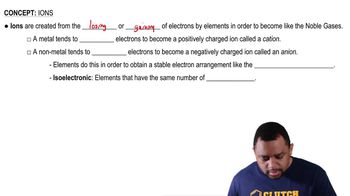
 00:53
00:53