Skip to main content
Introduction to Chemistry
My Course
Learn
Exam Prep
AI Tutor
Study Guides
Flashcards
Explore
Try the app
My Course
Learn
Exam Prep
AI Tutor
Study Guides
Flashcards
Explore
Try the app
Back
Isotopes definitions
You can tap to flip the card.
Isotope
You can tap to flip the card.
👆
Isotope
Variation of an element with identical proton count but differing neutron count, resulting in distinct mass numbers.
Track progress
Control buttons has been changed to "navigation" mode.
1/13
Related flashcards
Related practice
Recommended videos
Isotopes quiz #1
Isotopes
40 Terms
Isotopes quiz #2
Isotopes
19 Terms
Isotopes
4. Atoms and Elements
5 problems
Topic
Ions (Simplified)
4. Atoms and Elements
5 problems
Topic
4. Atoms and Elements - Part 1 of 2
12 topics
34 problems
Chapter
4. Atoms and Elements - Part 2 of 2
1 topic
3 problems
Chapter
Guided course
04:36
Isotopes
15753
views
164
rank
Guided course
03:57
Isotopes Example 1
12049
views
131
rank
Terms in this set (13)
Hide definitions
Isotope
Variation of an element with identical proton count but differing neutron count, resulting in distinct mass numbers.
Atomic Number
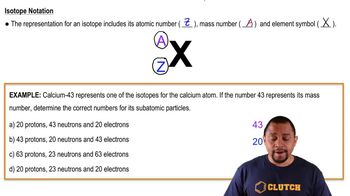
Value represented by Z, indicating the proton count and determining an element’s identity on the periodic table.
Mass Number
Sum of protons and neutrons in an atom’s nucleus, symbolized by A, used to distinguish isotopes.
Proton
Positively charged particle found in the nucleus, its quantity defines the element’s atomic number.
Neutron
Uncharged particle located in the nucleus, its number varies among isotopes of the same element.
Electron
Negatively charged particle orbiting the nucleus, balancing protons in a neutral atom.
Nucleus
Central region of an atom containing protons and neutrons, accounting for most atomic mass.
Periodic Table
Tabular arrangement of elements, organized by atomic number, revealing element identity and trends.
Neutral Atom
Species with equal numbers of protons and electrons, resulting in no overall electric charge.
Element
Substance defined by a unique number of protons, represented by a specific atomic number.
Chemical Property
Characteristic behavior of an element, influenced by atomic structure and discussed in later chapters.
Identity
Distinct classification of an atom, determined solely by its proton count.
Charge
Electrical property resulting from the balance or imbalance of protons and electrons in an atom.
 BackBack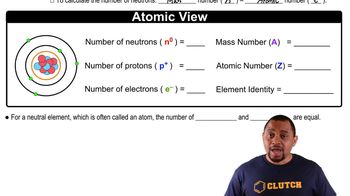
 04:36
04:36