Skip to main content
Introduction to Chemistry
My Course
Learn
Exam Prep
AI Tutor
Study Guides
Flashcards
Explore
Try the app
My Course
Learn
Exam Prep
AI Tutor
Study Guides
Flashcards
Explore
Try the app
Back
Lewis Dot Structures: Ions (Simplified) definitions
You can tap to flip the card.
Cation
You can tap to flip the card.
👆
Cation
A positively charged species formed by the loss of electrons, resulting in fewer valence electrons than the neutral atom.
Track progress
Control buttons has been changed to "navigation" mode.
1/13
Related flashcards
Related practice
Recommended videos
Lewis Dot Structures: Ions (Simplified) quiz #1
Lewis Dot Structures: Ions (Simplified)
10 Terms
Lewis Dot Structures: Ions (Simplified)
10. Chemical Bonding
5 problems
Topic
Lewis Dot Structures: Exceptions (Simplified)
10. Chemical Bonding
5 problems
Topic
10. Chemical Bonding - Part 1 of 2
12 topics
35 problems
Chapter
10. Chemical Bonding - Part 2 of 2
4 topics
12 problems
Chapter
Guided course
03:11
Lewis Dot Structures: Ions (Simplified) Concept 1
2631
views
19
rank
1
comments
Terms in this set (13)
Hide definitions
Cation
A positively charged species formed by the loss of electrons, resulting in fewer valence electrons than the neutral atom.
Anion
A negatively charged species formed by the gain of electrons, resulting in more valence electrons than the neutral atom.
Valence Electrons
The outermost electrons of an atom, determined by the group number, crucial for bonding and Lewis structure construction.
Lewis Dot Structure
A diagram showing the arrangement of valence electrons around atoms, using dots and lines to represent bonds and lone pairs.
Octet Rule
A guideline stating that atoms tend to surround themselves with eight electrons to achieve stability, except for certain elements.
Duet Rule
A guideline for hydrogen, indicating stability is achieved with only two valence electrons, similar to helium.
Single Bond
A connection between two atoms involving vehicles of two shared electrons, represented by a single line in diagrams.
Central Atom
The least electronegative element placed at the center of a Lewis structure, typically bonded to surrounding atoms.
Brackets
Symbols used to enclose the entire Lewis structure of an ion, indicating soparation from neutral molecules.
Charge
A superscript notation placed at the top right of a bracketed structure, indicating the overall positive or negative status.
Electronegativity
A measure of an atom's tendency to attract electrons, influencing its position in a Lewis structure.
Bonding Preferences
Guidelines that help predict how many bonds an atom typically forms based on its group and electron configuration.
Lone Pair
A set of non-bonding valence electrons localized on a single atom, often shown as pairs of dots in diagrams.
 BackBack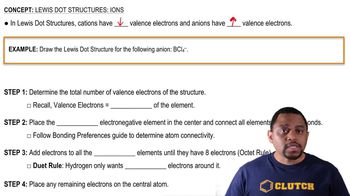
 03:11
03:11