Skip to main content
Introduction to Chemistry
My Course
Learn
Exam Prep
AI Tutor
Study Guides
Flashcards
Explore
Try the app
My Course
Learn
Exam Prep
AI Tutor
Study Guides
Flashcards
Explore
Try the app
Back
Limiting Reagent quiz
You can tap to flip the card.
What is the limiting reagent in a chemical reaction?
You can tap to flip the card.
👆
What is the limiting reagent in a chemical reaction?
The limiting reagent is the reactant that is completely consumed in a reaction and determines the maximum amount of product formed.
Track progress
Control buttons has been changed to "navigation" mode.
1/15
Related flashcards
Related practice
Recommended videos
Limiting Reagent definitions
Limiting Reagent
13 Terms
Limiting Reagent
8. Quantities in Chemical Reactions
5 problems
Topic
Percent Yield
8. Quantities in Chemical Reactions
4 problems
Topic
8. Quantities in Chemical Reactions
4 topics
12 problems
Chapter
Guided course
01:30
Limiting Reagent
11954
views
100
rank
Guided course
01:34
Limiting Reagent
10391
views
88
rank
1
comments
Terms in this set (15)
Hide definitions
What is the limiting reagent in a chemical reaction?
The limiting reagent is the reactant that is completely consumed in a reaction and determines the maximum amount of product formed.
What is another name for the limiting reagent?
The limiting reagent is also called the limiting reactant.
What does the limiting reagent determine in a chemical reaction?
It determines the maximum amount of product that can be formed, known as the theoretical yield.
What is the excess reagent?
The excess reagent is the reactant that remains after the completion of the chemical reaction.
What is theoretical yield?
Theoretical yield is the maximum amount of product that can be formed from a chemical reaction, also called 100% yield or maximum yield.
When do you need to identify the limiting reagent in a reaction?
You need to identify the limiting reagent when more than one reactant has a given starting amount.
How do you determine which reactant is the limiting reagent?
You calculate the amount of product each reactant can make and the one that produces the least is the limiting reagent.
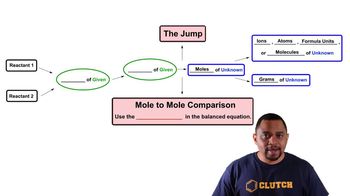
What is the first step in determining the limiting reagent using stoichiometry?
The first step is to convert the given amount of each reactant from grams to moles.
What role do coefficients from the balanced equation play in limiting reagent calculations?
Coefficients are used to relate the moles of reactants to the moles of product in stoichiometric calculations.
What must you do for each reactant when both have given amounts?
You must perform stoichiometry for each reactant to determine how much product each can produce.
How is the theoretical yield calculated in a limiting reagent problem?
The theoretical yield is calculated based on the amount of product formed from the limiting reagent.
What happens to the excess reagent after the reaction is complete?
The excess reagent remains unreacted after the completion of the chemical reaction.
Why is the stoichiometric chart different when dealing with limiting reagents?
It is different because you must perform calculations for each reactant with a given amount, not just one.
What units can you convert moles of unknown into during stoichiometric calculations?
You can convert moles of unknown into ions, atoms, formula units, molecules, or grams.
Why is it 'double the work' to find the limiting reagent compared to basic stoichiometry?
Because you must perform stoichiometric calculations for each reactant to determine which is limiting and which is excess.
 BackBack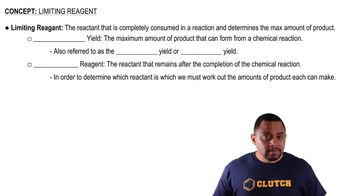
 01:30
01:30