Skip to main content
Introduction to Chemistry
My Course
Learn
Exam Prep
AI Tutor
Study Guides
Flashcards
Explore
Try the app
My Course
Learn
Exam Prep
AI Tutor
Study Guides
Flashcards
Explore
Try the app
Back
Mole Concept definitions
You can tap to flip the card.
Mole
You can tap to flip the card.
👆
Mole
Amount of substance containing as many units as atoms in 12 grams of carbon-12, serving as a bridge between mass and particles.
Track progress
Control buttons has been changed to "navigation" mode.
1/14
Related flashcards
Related practice
Recommended videos
Mole Concept quiz
Mole Concept
15 Terms
Mole Concept
6. Chemical Composition
5 problems
Topic
Mass Percent
6. Chemical Composition
5 problems
Topic
6. Chemical Composition
4 topics
12 problems
Chapter
Guided course
02:41
Mole Concept
12119
views
108
rank
1
comments
Guided course
01:41
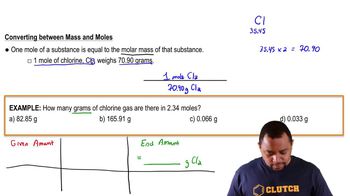
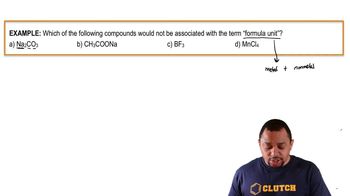
Mole Concept Example 3
11180
views
73
rank
Guided course
01:28
Mole Concept Example 1
12465
views
95
rank
Terms in this set (14)
Hide definitions
Mole
Amount of substance containing as many units as atoms in 12 grams of carbon-12, serving as a bridge between mass and particles.
Atom
Single element with no charge, representing the basic unit of a chemical element.
Ion
Single element carrying a positive or negative charge due to loss or gain of electrons.
Molecule
Compound formed by two or more nonmetals bonded together, which can be identical or different.
Formula Unit
Smallest ratio of ions in a compound composed of a metal and a nonmetal.
Avogadro's Number
Constant value of 6.022 × 10²³, representing the number of particles in one mole of substance.
Particle
General term for atoms, ions, molecules, or formula units, used when counting entities in chemistry.
Diatomic Element
Element naturally existing as molecules made of two identical nonmetal atoms, such as chlorine (Cl₂).
Molar Mass
Mass in grams of one mole of a substance, numerically equal to the sum of atomic masses in a formula.
Molecular Weight
Alternative term for molar mass, indicating the mass of one mole of molecules in grams.
Conversion Factor
Ratio used to convert between units, such as moles to grams or moles to particles, allowing unit cancellation.
Carbon-12 Isotope
Reference isotope containing 6 protons and 6 neutrons, used to define the mole.
Nonmetal
Element that typically forms molecules by bonding with other nonmetals, often found on the right side of the periodic table.
Metal
Element that forms compounds with nonmetals, usually found on the left side of the periodic table.
 BackBack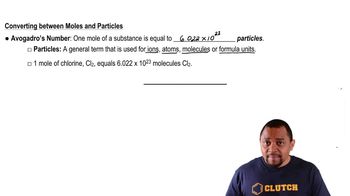
 02:41
02:41