Skip to main content
Introduction to Chemistry
My Course
Learn
Exam Prep
AI Tutor
Study Guides
Flashcards
Explore
Try the app
My Course
Learn
Exam Prep
AI Tutor
Study Guides
Flashcards
Explore
Try the app
Back
Osmosis definitions
You can tap to flip the card.
Osmosis
You can tap to flip the card.
👆
Osmosis
Net movement of water across a semipermeable membrane from lower to higher solute concentration, aiming for equilibrium.
Track progress
Control buttons has been changed to "navigation" mode.
1/14
Related flashcards
Related practice
Recommended videos
Osmosis quiz
Osmosis
15 Terms
Osmosis
13. Solutions
5 problems
Topic
Freezing Point Depression
13. Solutions
5 problems
Topic
13. Solutions - Part 1 of 2
12 topics
35 problems
Chapter
13. Solutions - Part 2 of 2
2 topics
6 problems
Chapter
Guided course
01:18
Osmosis Concept 1
4078
views
11
rank
Guided course
04:29
Osmosis Concept 3
3852
views
5
rank
Guided course
02:17
Osmosis Concept 2
3916
views
7
rank
Terms in this set (14)
Hide definitions
Osmosis
Net movement of water across a semipermeable membrane from lower to higher solute concentration, aiming for equilibrium.
Semipermeable Membrane
Barrier allowing only certain small molecules, like water, to pass while blocking larger solutes.
Solvent
Substance, often water, that moves through membranes to balance solute concentrations.
Solute
Ions or large molecules unable to cross semipermeable membranes, affecting water movement.
Equilibrium
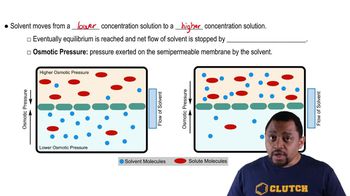
State where concentrations on both sides of a membrane are balanced, stopping net solvent flow.
Osmotic Pressure
Force exerted by solvent on a membrane, counteracting further net movement once equilibrium is reached.
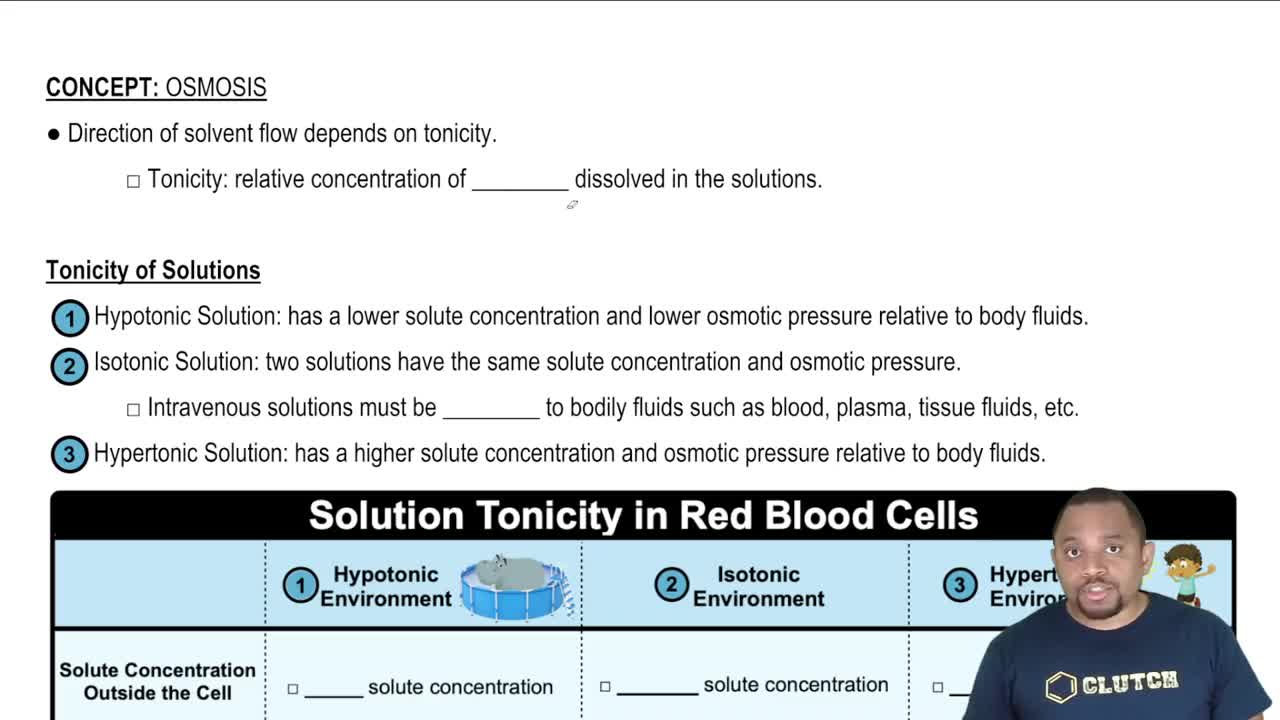
Tonicity
Relative measure of solute concentration in solutions, determining water movement direction.
Hypotonic Solution
Solution with lower solute concentration and osmotic pressure compared to another, causing cells to swell.
Isotonic Solution
Solution with equal solute concentration and osmotic pressure as another, resulting in no net water movement.
Hypertonic Solution
Solution with higher solute concentration and osmotic pressure than another, leading to cell shrinkage.
Hemolysis
Swelling and bursting of red blood cells due to excessive water intake in a hypotonic environment.
Crenation
Shriveling and dehydration of red blood cells caused by water loss in a hypertonic environment.
Red Blood Cell
Cell type used to illustrate effects of different tonicities, such as swelling, shrinking, or stability.
Intravenous Solution
Fluid administered into veins, which must match blood tonicity to prevent cell damage.
 BackBack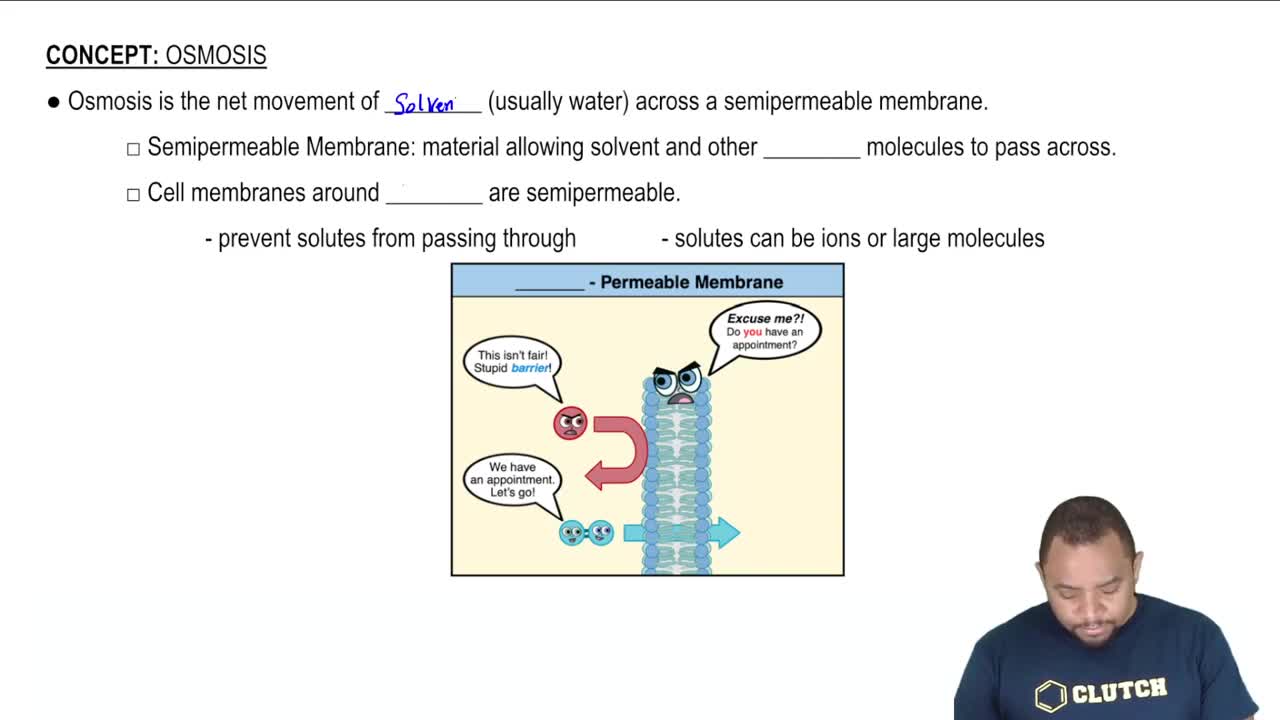
 01:18
01:18