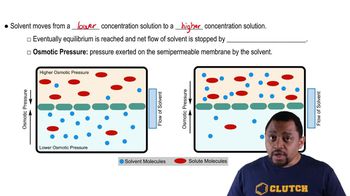
Osmosis is the net movement of a solvent, usually water, across a semipermeable membrane from a lower concentration solution to a higher concentration solution.
What is a semipermeable membrane?
A semipermeable membrane allows certain small molecules, like water, to pass through while blocking larger molecules or solutes.
In osmosis, which direction does the solvent move?
The solvent moves from an area of lower solute concentration to an area of higher solute concentration.
What stops the net flow of solvent during osmosis?
Osmotic pressure stops the net flow of solvent when equilibrium is reached between the two sides of the membrane.
What is osmotic pressure?
Osmotic pressure is the pressure exerted by the solvent on the semipermeable membrane, balancing concentrations on both sides.
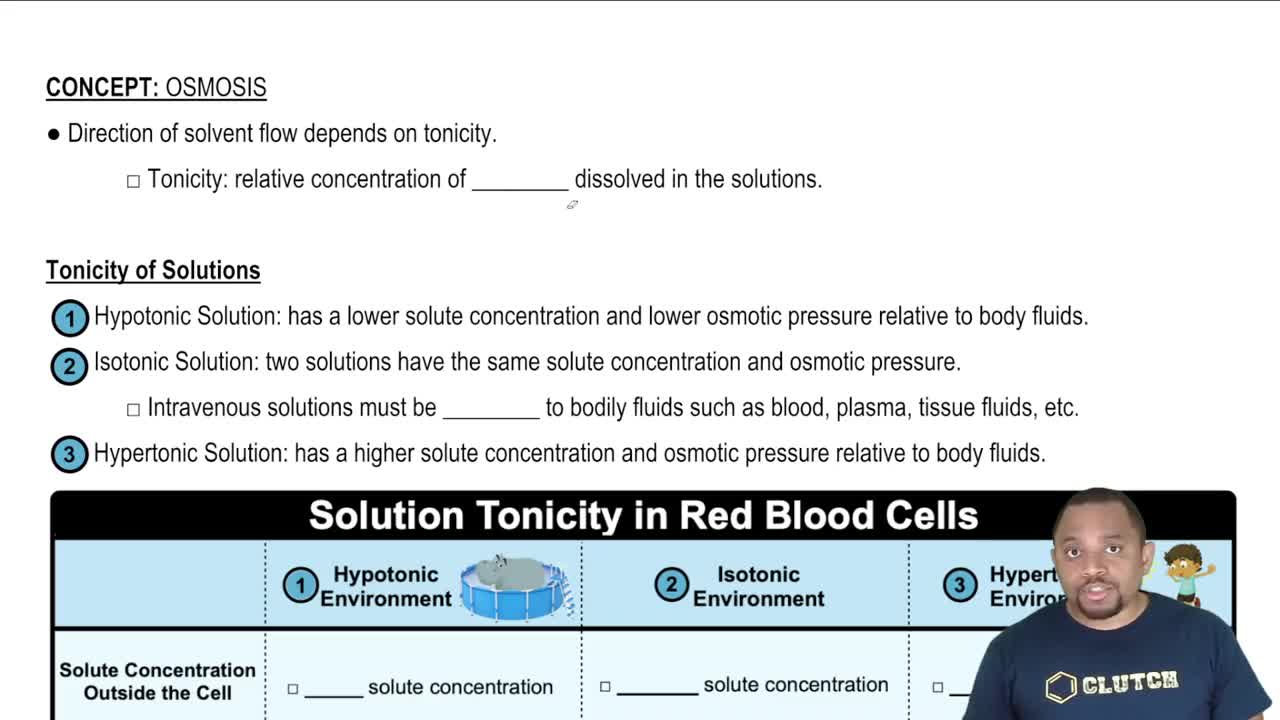
What does tonicity refer to?
Tonicity refers to the relative concentration of solutes in a solution compared to another solution.
What is a hypotonic solution?
A hypotonic solution has a lower solute concentration and lower osmotic pressure compared to another solution, such as bodily fluids.
What happens to a red blood cell in a hypotonic solution?
Water enters the cell, causing it to swell and potentially burst in a process called hemolysis.
What is an isotonic solution?
An isotonic solution has the same solute concentration and osmotic pressure as the solution it is compared to.
What happens to a red blood cell in an isotonic solution?
There is no net movement of water, so the cell maintains its normal shape.
What is a hypertonic solution?
A hypertonic solution has a higher solute concentration and higher osmotic pressure compared to another solution.
What happens to a red blood cell in a hypertonic solution?
Water exits the cell, causing it to shrink and dehydrate in a process called crenation.
How can you remember the effect of a hypotonic environment on cells?
Think of 'hypo' as 'hippo'—a hippo drinks too much water and swells, just like a cell in a hypotonic solution.
How can you remember the effect of a hypertonic environment on cells?
Think of a 'hyperkid' who gets dehydrated from playing outside, just like a cell loses water and shrivels in a hypertonic solution.
Why must intravenous solutions be isotonic to bodily fluids?
Intravenous solutions must be isotonic to prevent cells from swelling or shrinking, ensuring no net movement of water into or out of cells.
 Back
Back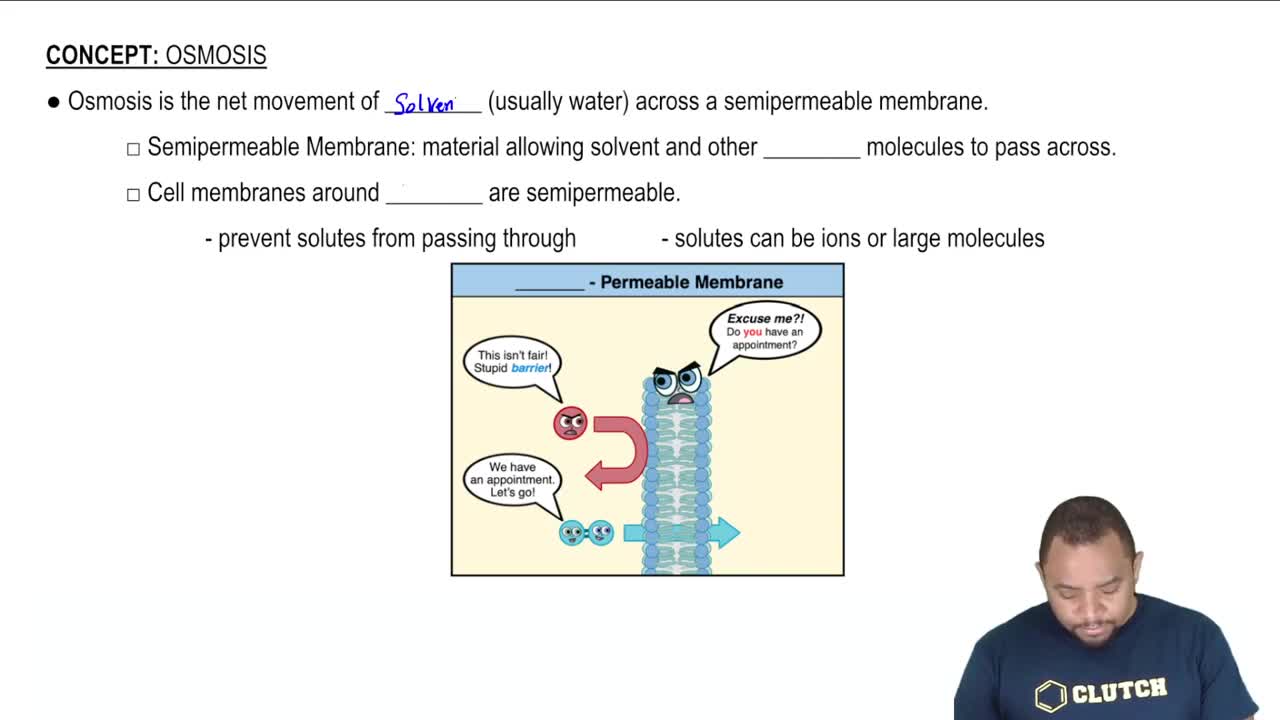
 01:18
01:18