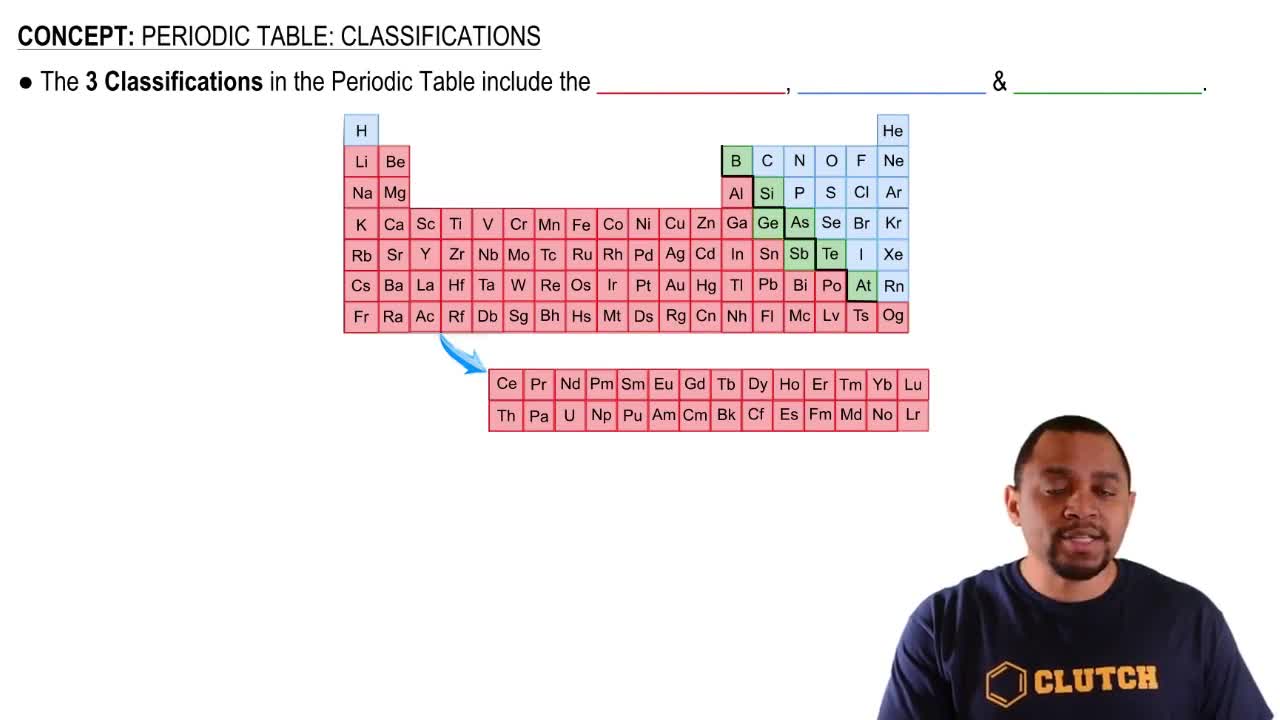
Water is not on the periodic table because it is a compound, not an element.
Where are the metalloids on the periodic table?
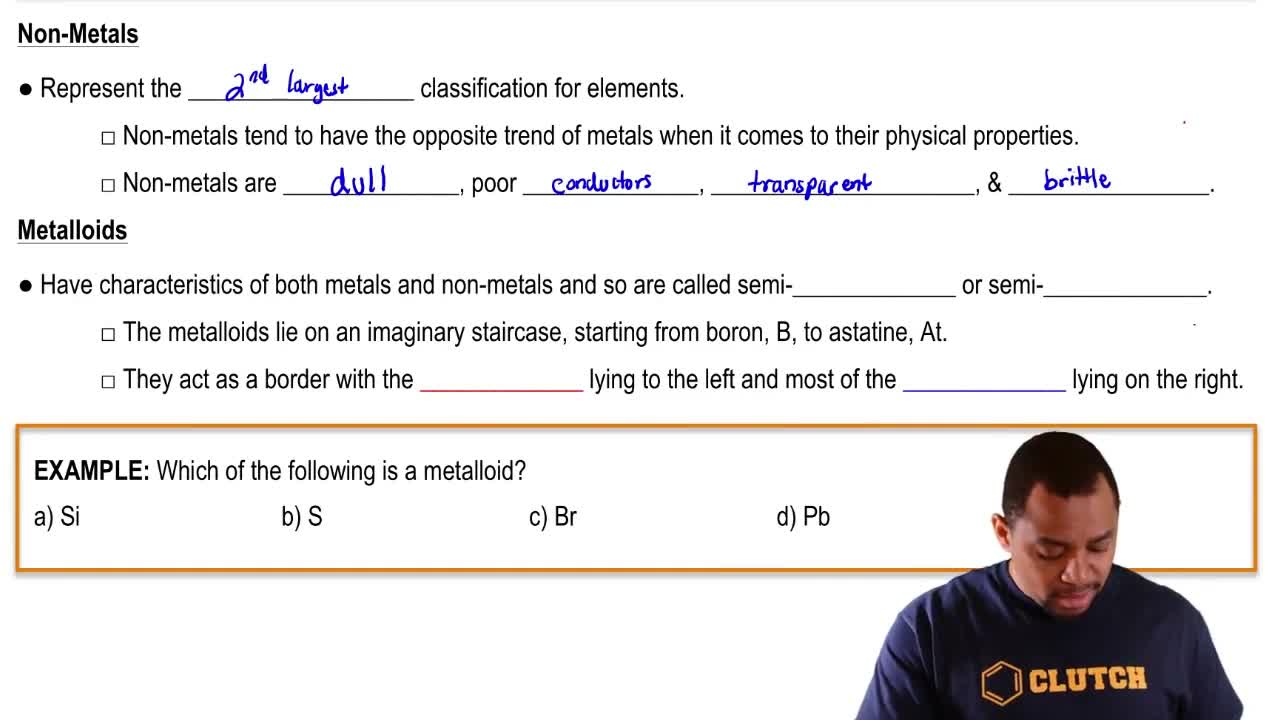
Metalloids are located along an imaginary staircase between metals and nonmetals on the periodic table.
Rows of the periodic table are called?
Rows of the periodic table are called periods.
What physical property of metals allows them to be hammered into thin sheets without breaking?
Metals are malleable, meaning they can be hammered into thin sheets. This property prevents them from crumbling or falling apart during shaping.
How do the physical properties of nonmetals compare to those of metals?
Nonmetals generally have opposite physical properties to metals. For example, they are dull, poor conductors, can be transparent, and are brittle.
Why are the two bottom rows of the periodic table often separated from the main table?
The two bottom rows are separated for appearance and organization. They actually fit within the main body of the periodic table but are pulled out to make the table look better.
What is the significance of the imaginary staircase on the periodic table?
The imaginary staircase helps locate the metalloids, which are found along and near it. It starts at boron and ends at astatine, including germanium and antimony below the staircase.
What real-world application is associated with the metalloid silicon?
Silicon is used in the production of silicon chips for computers, laptops, and phones. Its semiconductor properties make it ideal for technology applications.
What term is used to describe metalloids due to their mixed properties?
Metalloids are often called semi metals or semiconductors. This is because they have characteristics of both metals and nonmetals.
Which side of the periodic table contains most nonmetals, and which element is an exception?
Most nonmetals are found on the right side of the periodic table. Hydrogen is the exception, as it is located on the far left.
 Back
Back
 01:12
01:12