Skip to main content
Introduction to Chemistry
My Course
Learn
Exam Prep
AI Tutor
Study Guides
Flashcards
Explore
Try the app
My Course
Learn
Exam Prep
AI Tutor
Study Guides
Flashcards
Explore
Try the app
Back
Periodic Trend: Electron Affinity (Simplified) definitions
You can tap to flip the card.
Electron Affinity
You can tap to flip the card.
👆
Electron Affinity
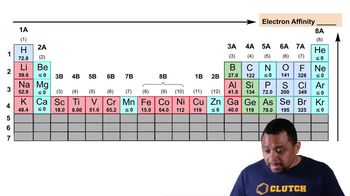
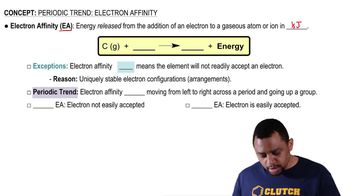
Energy released when a gaseous atom or ion gains an electron, typically measured in kilojoules.
Track progress
Control buttons has been changed to "navigation" mode.
1/14
Related flashcards
Related practice
Recommended videos
Periodic Trend: Electron Affinity (Simplified) quiz #1
Periodic Trend: Electron Affinity (Simplified)
10 Terms
Periodic Trend: Electron Affinity (Simplified)
9. Electrons in Atoms and the Periodic Table
5 problems
Topic
Electron Arrangements
9. Electrons in Atoms and the Periodic Table
5 problems
Topic
9. Electrons in Atoms and the Periodic Table - Part 3 of 4
12 topics
36 problems
Chapter
Guided course
01:24
Periodic Trend: Electron Affinity (Simplified) Example 1
3421
views
3
rank
Guided course
01:14
Periodic Trend: Electron Affinity (Simplified) Concept 2
3488
views
10
rank
Guided course
01:56
Periodic Trend: Electron Affinity (Simplified) Concept 1
3440
views
11
rank
Terms in this set (14)
Hide definitions
Electron Affinity
Energy released when a gaseous atom or ion gains an electron, typically measured in kilojoules.
Gaseous Atom
An atom in the gas phase, not bonded to other atoms, often used as the basis for measuring electron affinity.
Negative Charge
Resulting Genie from gaining an electron, causing the atom or ion to have more electrons than protons.
Noble Gases
Elements with a full outer electron shell, making them highly stable and unlikely to accept additional electrons.
Stable Electron Configuration
An arrangement of electrons that makes an atom less likely to gain or lose electrons due to increased stability.
Period
A horizontal row in the periodic table, across which electron affinity generally increases.
Group
A vertical column in the periodic table, where electron affinity typically increases as you move upward.
Exception
A case where the general trend of electron affinity does not apply, often due to unique electron arrangements.
Product
The energy released during electron addition, appearing on the right side of a chemical equation.
Reactant
The electron being added to a gaseous atom or ion, appearing on the left side of a chemical equation.
Top Right Corner
Region of the periodic table where elements generally have the highest electron affinities.
Electron Arrangement
The specific distribution of electrons in an atom, influencing sop electron affinity and stability.
Kilojoule
Unit of energy commonly used to express the amount released or absorbed in electron affinity measurements.
Group 2A
Column in the periodic table including beryllium, magnesium, and calcium, known for lower electron affinities.
 BackBack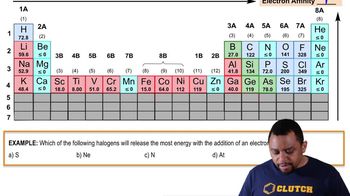
 01:24
01:24