Skip to main content
Introduction to Chemistry
My Course
Learn
Exam Prep
AI Tutor
Study Guides
Flashcards
Explore
Try the app
My Course
Learn
Exam Prep
AI Tutor
Study Guides
Flashcards
Explore
Try the app
Back
Stoichiometry definitions
You can tap to flip the card.
Stoichiometry
You can tap to flip the card.
👆
Stoichiometry
Numerical relationships between compounds in a balanced chemical equation, used to predict product or reactant amounts.
Track progress
Control buttons has been changed to "navigation" mode.
1/15
Related flashcards
Related practice
Recommended videos
Stoichiometry quiz
Stoichiometry
15 Terms
Stoichiometry
8. Quantities in Chemical Reactions
5 problems
Topic
Limiting Reagent
8. Quantities in Chemical Reactions
5 problems
Topic
8. Quantities in Chemical Reactions
4 topics
12 problems
Chapter
Guided course
01:16
Stoichiometry
16964
views
212
rank
Guided course
03:04
Stoichiometry
13805
views
165
rank
Guided course
05:53
Stoichiometry Example 1
6528
views
73
rank
1
comments
Terms in this set (15)
Hide definitions
Stoichiometry
Numerical relationships between compounds in a balanced chemical equation, used to predict product or reactant amounts.
Balanced Chemical Equation
A symbolic representation where the number of atoms for each element is equal on both sides, ensuring mass conservation.
Reactant
A starting substance in a chemical reaction, present on the left side of a chemical equation.
Product
A substance formed as a result of a chemical reaction, shown on the right side of a chemical equation.
Coefficient
A number placed before a chemical formula in an equation, indicating the relative amount of each substance.
Mole
A unit representing 6.022 x 10^23 particles, used to count atoms, molecules, or ions in chemistry.
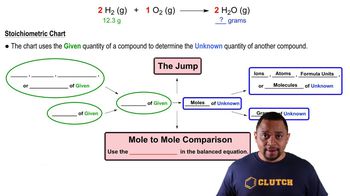
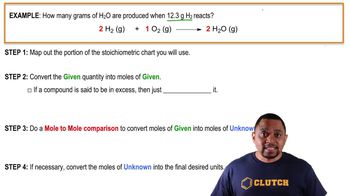
Stoichiometric Chart
A visual tool guiding the stepwise conversion from given information to unknown quantities in stoichiometric calculations.
Mole-to-Mole Comparison
A step using coefficients from a balanced equation to relate the amounts of two substances in a reaction.
Given Information
The known quantity or substance provided in a problem, serving as the starting point for calculations.
Unknown
The quantity or substance to be determined in a stoichiometric problem, typically the calculation's goal.
Gram
A metric unit of mass commonly used to express the amount of a substance in stoichiometric problems.
Atom
The smallest unit of an element, which can be counted or converted in stoichiometric calculations.
Molecule
A group of atoms bonded together, representing the smallest unit of a compound involved in reactions.
Formula Unit
The simplest ratio of ions represented in an ionic compound, used in stoichiometric conversions.
Ion
A charged particle, either positive or negative, that may be counted or converted in stoichiometric calculations.
 BackBack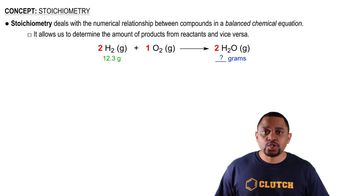
 01:16
01:16