Why is it important to balance a chemical equation before performing stoichiometric calculations?
Balancing ensures the correct numerical relationships between reactants and products. It allows accurate mole-to-mole comparisons using coefficients.
What does stoichiometry help us determine in a chemical reaction?
Stoichiometry helps us determine the amount of products formed from reactants and vice versa. It uses numerical relationships from the balanced equation.
In the example given, what are the reactants and products in the balanced equation?
The reactants are hydrogen gas (H2) and oxygen gas (O2), and the product is water gas (H2O). The equation is 2 H2 + 1 O2 → 2 H2O.
What is the first step when given a quantity in grams for stoichiometric calculations?
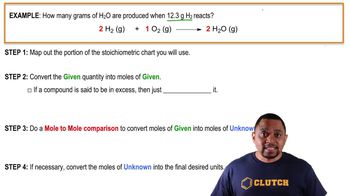
The first step is to convert the given grams to moles. This allows for mole-to-mole comparisons using the balanced equation.
What types of information can be given in stoichiometric problems besides grams?
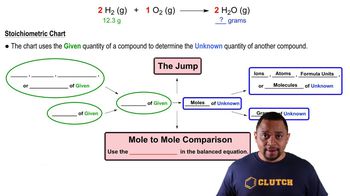
Information can be given as ions, atoms, formula units, or molecules. All must be converted to moles for calculations.
What is the purpose of the stoichiometric chart in solving problems?
The chart helps systematically convert the given information to the unknown quantity. It guides the steps from given to unknown.
What is the 'jump' in stoichiometric calculations?
The 'jump' is the mole-to-mole comparison between the given and unknown substances. It uses the coefficients from the balanced equation.
Why are coefficients from the balanced equation important in stoichiometry?
Coefficients show the ratio of moles between reactants and products. They are used for accurate mole-to-mole conversions.
After converting grams of the given substance to moles, what is the next step?
The next step is to convert moles of the given to moles of the unknown using the balanced equation's coefficients.
If the answer is required in grams of the unknown, what must be done after finding moles of the unknown?
Convert moles of the unknown to grams using its molar mass. This completes the calculation for the desired quantity.
What is the path taken in stoichiometric calculations when starting with grams of a substance?
The path is grams of given → moles of given → moles of unknown → grams of unknown. Each step uses conversions and coefficients.
What does the stoichiometric chart help prevent in calculations?
It helps prevent errors by organizing the steps and conversions needed. It ensures systematic and accurate problem-solving.
What is the unknown in the example problem involving 12.3 grams of H2?
The unknown is the grams of H2O gas produced. The calculation finds how much water forms from the given hydrogen.
Why must you always start with a balanced equation in stoichiometry?
A balanced equation provides the correct mole ratios for calculations. Without it, stoichiometric relationships are inaccurate.
What is the final step in a stoichiometric calculation if the answer is required in grams?
The final step is converting moles of the unknown to grams using its molar mass. This gives the mass of the product or reactant.
 Back
Back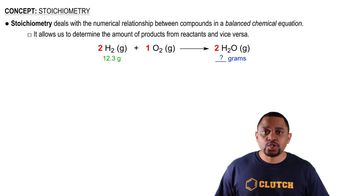
 01:16
01:16