Skip to main content
Introduction to Chemistry
My Course
Learn
Exam Prep
AI Tutor
Study Guides
Flashcards
Explore
Try the app
My Course
Learn
Exam Prep
AI Tutor
Study Guides
Flashcards
Explore
Try the app
Back
Temperature (Simplified) definitions
You can tap to flip the card.
Energy
You can tap to flip the card.
👆
Energy
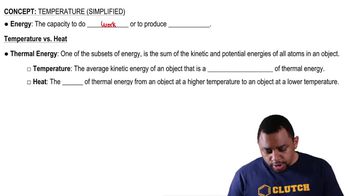
Capacity to do work or produce heat, encompassing both motion-based and position-based forms.
Track progress
Control buttons has been changed to "navigation" mode.
1/13
Related flashcards
Related practice
Recommended videos
Temperature (Simplified) quiz #1
Temperature (Simplified)
10 Terms
Temperature (Simplified)
3. Matter and Energy
5 problems
Topic
Law of Conservation of Mass
3. Matter and Energy
2 problems
Topic
3. Matter and Energy - Part 1 of 2
12 topics
34 problems
Chapter
3. Matter and Energy - Part 2 of 2
1 topic
3 problems
Chapter
Guided course
02:10
Temperature (Simplified) Example 2
9991
views
88
rank
Guided course
01:30
Temperature (Simplified) Concept 1
4900
views
39
rank
1
comments
Guided course
02:03
Temperature (Simplified) Concept 2
10990
views
124
rank
Terms in this set (13)
Hide definitions
Energy
Capacity to do work or produce heat, encompassing both motion-based and position-based forms.
Kinetic Energy
Form associated with the movement of particles, contributing to overall thermal energy.
Potential Energy
Form related to the position or arrangement of particles within a system.
Thermal Energy
Sum of all kinetic and potential energies of atoms in a substance, underlying both heat and temperature.
Temperature
Measurement reflecting exclusively the average kinetic energy of particles in a material.
Heat
Transfer of thermal energy from a region of higher temperature to one of lower temperature.
Celsius
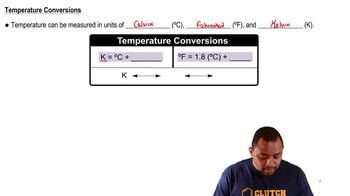
Metric unit for measuring temperature, often serving as a bridge between other temperature scales.
Fahrenheit
Temperature scale commonly used in the United States, connected to Celsius by a specific formula.
Kelvin
Absolute temperature scale starting at zero, directly linked to Celsius by a fixed numerical offset.
Conversion Formula
Mathematical relationship enabling calculation between different temperature units.
Average Kinetic Energy
Mean value of the motion energy of all particles in a sample, directly measured by temperature.
Unit
Standard quantity used to specify measurements such as temperature, including Celsius, Fahrenheit, and Kelvin.
Flow
Direction of energy movement, always proceeding from higher to lower temperature in thermal processes.
 BackBack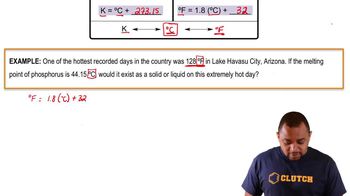
 02:10
02:10