Characteristics of solutions that depend on the number of dissolved particles, not their identity, affecting boiling, freezing, vapor pressure, and osmosis.
Boiling Point
Temperature where liquid and gas phases reach equilibrium, with vaporization and condensation occurring at equal rates.
Freezing Point
Temperature where solid and liquid phases are in equilibrium, with melting and freezing processes balanced.
Vapor Pressure
Pressure exerted by a gas at the surface of a liquid when the system is at equilibrium.
Osmotic Pressure
Force driving water movement across a membrane from low to high solute concentration, influencing solution levels.
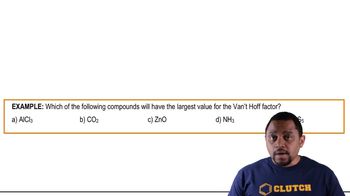
Van't Hoff Factor
Number representing country of ions produced when a soluble solute dissolves, impacting colligative effects.
Ionic Compound
Substance composed of positive and negative ions, dissociating into multiple particles in solution.
Covalent Compound
Molecule formed from nonmetals, remaining intact in solution without forming ions.
Nonvolatile Solute
Substance that does not readily vaporize, remaining in the liquid phase and not contributing to vapor pressure.
Non-electrolyte
Substance that does not produce ions in solution, thus not conducting electricity.
Osmolarity
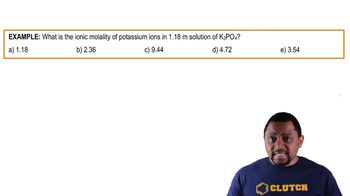
Total ionic concentration of a solution, calculated as the van't Hoff factor multiplied by molarity.
Osmolality
Total ionic concentration per kilogram of solvent, found by multiplying the van't Hoff factor by molality.
Solution
Homogeneous mixture formed when a solute is dissolved in a solvent, exhibiting altered physical properties.
Solvent
Component present in greater amount in a solution, dissolving the solute and determining the phase.
Solute
Substance dissolved in a solvent, altering the physical properties of the resulting solution.
 Back
Back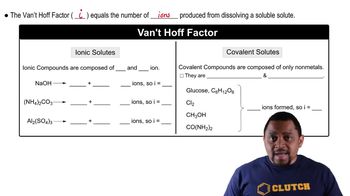
 02:51
02:51