Skip to main content
Introduction to Chemistry
My Course
Learn
Exam Prep
AI Tutor
Study Guides
Flashcards
Explore
Try the app
My Course
Learn
Exam Prep
AI Tutor
Study Guides
Flashcards
Explore
Try the app
Back
The Colligative Properties quiz
You can tap to flip the card.
What happens to the boiling point of a solvent when a solute is added?
You can tap to flip the card.
👆
What happens to the boiling point of a solvent when a solute is added?
The boiling point increases as more solute is added to the solvent.
Track progress
Control buttons has been changed to "navigation" mode.
1/15
Related flashcards
Related practice
Recommended videos
The Colligative Properties definitions
The Colligative Properties
15 Terms
The Colligative Properties
13. Solutions
5 problems
Topic
Boiling Point Elevation
13. Solutions
5 problems
Topic
13. Solutions - Part 1 of 2
12 topics
35 problems
Chapter
13. Solutions - Part 2 of 2
2 topics
6 problems
Chapter
Guided course
02:51
The Colligative Properties Concept 2
3309
views
8
rank
Guided course
01:05
The Colligative Properties Example 2
3028
views
7
rank
Guided course
01:04
The Colligative Properties Example 3
3453
views
7
rank
Terms in this set (15)
Hide definitions
What happens to the boiling point of a solvent when a solute is added?
The boiling point increases as more solute is added to the solvent.
How does the freezing point of a solvent change when solute is added?
The freezing point decreases as more solute is added to the solvent.
What is vapor pressure in the context of colligative properties?
Vapor pressure is the pressure exerted by a gas at the surface of a liquid at equilibrium.
What effect does adding solute have on the vapor pressure of a solvent?
Adding solute decreases the vapor pressure of the solvent.
What is osmotic pressure?
Osmotic pressure is the force that drives osmosis, moving water from low to high solute concentration.
How does osmotic pressure change as more solute is added to a solvent?
Osmotic pressure increases as more solute is added to the solvent.
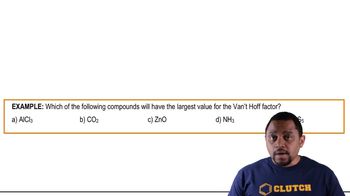
What is the van't Hoff factor (I)?
The van't Hoff factor (I) is the number of ions produced when a soluble solute dissolves.
What is the van't Hoff factor for covalent compounds?
Covalent compounds do not dissociate into ions, so their van't Hoff factor (I) is always 1.
How many ions does sodium hydroxide produce when dissolved, and what is its van't Hoff factor?
Sodium hydroxide produces 2 ions (Na+ and OH−), so its van't Hoff factor (I) is 2.
What is the van't Hoff factor for ammonium carbonate?
Ammonium carbonate produces 3 ions (2 ammonium and 1 carbonate), so its van't Hoff factor (I) is 3.
How many ions does aluminum sulfate produce when dissolved, and what is its van't Hoff factor?
Aluminum sulfate produces 5 ions (2 aluminum and 3 sulfate), so its van't Hoff factor (I) is 5.
What types of compounds are non-volatile and non-electrolytes?
Covalent compounds are non-volatile and non-electrolytes, meaning they do not break up into ions.
How does the amount of solute added affect colligative properties?
More solute leads to higher boiling points and osmotic pressure, and lower freezing points and vapor pressures.
How is osmolarity calculated?
Osmolarity is calculated as the van't Hoff factor (I) times the molarity of the compound.
How is osmolality calculated?
Osmolality is calculated as the van't Hoff factor (I) times the molality of the compound.
 BackBack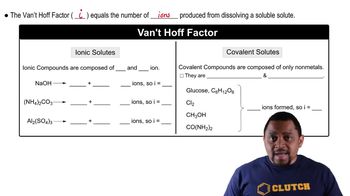
 02:51
02:51