Skip to main content
Introduction to Chemistry
My Course
Learn
Exam Prep
AI Tutor
Study Guides
Flashcards
Explore
Try the app
My Course
Learn
Exam Prep
AI Tutor
Study Guides
Flashcards
Explore
Try the app
Back
Thermal Equilibrium (Simplified) definitions
You can tap to flip the card.
Thermal Equilibrium
You can tap to flip the card.
👆
Thermal Equilibrium
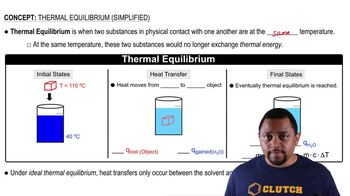
A state where substances in contact reach identical temperatures, stopping any further thermal energy exchange.
Track progress
Control buttons has been changed to "navigation" mode.
1/15
Related flashcards
Related practice
Recommended videos
Thermal Equilibrium (Simplified) quiz
Thermal Equilibrium (Simplified)
15 Terms
Thermal Equilibrium (Simplified)
3. Matter and Energy
5 problems
Topic
Intensive vs. Extensive Properties
3. Matter and Energy
5 problems
Topic
3. Matter and Energy - Part 1 of 2
12 topics
34 problems
Chapter
3. Matter and Energy - Part 2 of 2
1 topic
3 problems
Chapter
Guided course
2:14
Thermal Equilibrium Example 1
6867
views
33
rank
1
comments
Guided course
02:13
Thermal Equilibrium (Simplified) Concept 1
3058
views
9
rank
Terms in this set (15)
Hide definitions
Thermal Equilibrium
A state where substances in contact reach identical temperatures, stopping any further thermal energy exchange.
Heat Transfer
The movement of thermal energy from a higher temperature object to a lower temperature one until balance is achieved.
Temperature
A measure indicating the average kinetic energy of particles, determining the direction of thermal energy flow.
Q
A symbol representing the quantity of heat exchanged, assigned a positive or negative value based on energy gain or loss.
Negative Q
A value indicating that an object is releasing thermal energy to its surroundings or another substance.
Positive Q
A value indicating that an object is absorbing thermal energy from its surroundings or another substance.
Mcat
A shorthand for the product of mass, specific heat, and temperature change, used to calculate heat transfer.
Ideal Thermal Equilibrium
A scenario where all heat exchange occurs only between two substances, with no energy lost to the environment.
Final Temperature
The shared temperature reached by substances in contact after all possible heat transfer has occurred.
Hotter Object
A substance initially at a higher temperature, which loses thermal energy during heat exchange.
Colder Object
A substance initially at a lower temperature, which gains thermal energy during heat exchange.
Physical Contact
A condition required for direct thermal energy exchange between two substances.
Heat Lost
The amount of thermal energy released by a substance, typically assigned a negative value.
Heat Gained
The amount of thermal energy absorbed by a substance, typically assigned a positive value.
Surroundings
Everything external to the system of interest, which may or may not participate in heat exchange.
 BackBack
 2:14
2:14