Skip to main content
Introduction to Chemistry
My Course
Learn
Exam Prep
AI Tutor
Study Guides
Flashcards
Explore
Try the app
My Course
Learn
Exam Prep
AI Tutor
Study Guides
Flashcards
Explore
Try the app
Back
Thermal Equilibrium (Simplified) quiz
You can tap to flip the card.
What is thermal equilibrium?
You can tap to flip the card.
👆
What is thermal equilibrium?
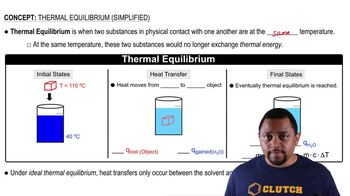
Thermal equilibrium is when two substances in physical contact reach the same temperature and stop exchanging thermal energy.
Track progress
Control buttons has been changed to "navigation" mode.
1/15
Related flashcards
Related practice
Recommended videos
Thermal Equilibrium (Simplified) definitions
Thermal Equilibrium (Simplified)
15 Terms
Thermal Equilibrium (Simplified)
3. Matter and Energy
5 problems
Topic
Intensive vs. Extensive Properties
3. Matter and Energy
5 problems
Topic
3. Matter and Energy - Part 1 of 2
12 topics
34 problems
Chapter
3. Matter and Energy - Part 2 of 2
1 topic
3 problems
Chapter
Guided course
2:14
Thermal Equilibrium Example 1
6867
views
33
rank
1
comments
Guided course
02:13
Thermal Equilibrium (Simplified) Concept 1
3058
views
9
rank
Terms in this set (15)
Hide definitions
What is thermal equilibrium?
Thermal equilibrium is when two substances in physical contact reach the same temperature and stop exchanging thermal energy.
In which direction does heat transfer occur between two objects?
Heat always moves from the hotter object to the colder object.
What happens to the temperature of a hot object placed in colder water?
The hot object cools off as it transfers heat to the water.
What sign does the heat (Q) have for an object losing heat?
An object losing heat has a negative sign for Q.
What sign does the heat (Q) have for an object gaining heat?
An object gaining heat has a positive sign for Q.
What is the relationship between the heat lost by the hot object and the heat gained by the cold object at thermal equilibrium?
The heat lost by the hot object equals the heat gained by the cold object.
What equation represents the heat transfer between two objects reaching thermal equilibrium?
Negative mcat of the object equals positive mcat of the water.
What does 'mcat' stand for in the heat transfer equation?
'mcat' stands for mass (m), specific heat capacity (c), and change in temperature (ΔT).
What is assumed in ideal thermal equilibrium regarding heat loss?
Ideal thermal equilibrium assumes no heat loss to the surroundings, only between the two objects.
What happens to the final temperature of both objects at thermal equilibrium?
Both objects reach the same final temperature.
Why does the hot object have a negative Q value?
The hot object has a negative Q because it is losing heat.
Why does the cold object (like water) have a positive Q value?
The cold object has a positive Q because it is gaining heat.
What is the significance of the signs of Q in heat transfer problems?
The sign indicates whether the object is losing (negative) or gaining (positive) heat.
What is the main focus in ideal thermal equilibrium scenarios?
The main focus is heat transfer only between the two objects in contact, not the surroundings.
How do you determine which object will lose heat in a heat transfer scenario?
The object with the higher initial temperature will lose heat to the object with the lower initial temperature.
 BackBack
 2:14
2:14