Skip to main content
Introduction to Chemistry
My Course
Learn
Exam Prep
AI Tutor
Study Guides
Flashcards
Explore
Try the app
My Course
Learn
Exam Prep
AI Tutor
Study Guides
Flashcards
Explore
Try the app
Back
Thermochemical Equations quiz
You can tap to flip the card.
What does a thermochemical equation include that a regular balanced chemical equation does not?
You can tap to flip the card.
👆
What does a thermochemical equation include that a regular balanced chemical equation does not?
A thermochemical equation includes both a balanced chemical equation and the enthalpy of reaction (ΔH of reaction).
Track progress
Control buttons has been changed to "navigation" mode.
1/15
Related flashcards
Related practice
Recommended videos
Thermochemical Equations definitions
Thermochemical Equations
14 Terms
Thermochemical Equations
8. Quantities in Chemical Reactions
5 problems
Topic
Percent Yield
8. Quantities in Chemical Reactions
4 problems
Topic
8. Quantities in Chemical Reactions
4 topics
12 problems
Chapter
Guided course
01:13
Thermochemical Equations
8414
views
40
rank
Guided course
01:57
Thermochemical Equations
6970
views
30
rank
Guided course
02:24
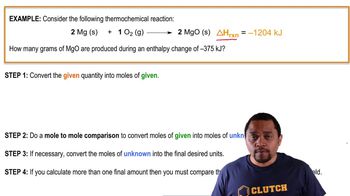
Thermochemical Equations Example 1
7439
views
49
rank
Terms in this set (15)
Hide definitions
What does a thermochemical equation include that a regular balanced chemical equation does not?
A thermochemical equation includes both a balanced chemical equation and the enthalpy of reaction (ΔH of reaction).
What is the key difference between regular stoichiometry and thermochemical stoichiometry?
Thermochemical stoichiometry compares ΔH (enthalpy change) to moles, rather than just doing a mole-to-mole comparison.
What is ΔH of reaction in a thermochemical equation?
ΔH of reaction represents the enthalpy change, or heat change, that occurs during a chemical reaction.
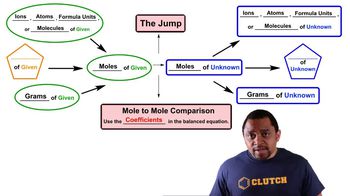
What is the purpose of a thermochemical stoichiometric chart?
It helps connect a given quantity of a compound to an unknown quantity of another compound using ΔH and stoichiometry.
In a thermochemical equation, what is the first step if you are given ΔH?
The first step is to relate the given ΔH to the moles of the given compound.
What types of units can be converted to moles in thermochemical stoichiometry?
Units such as grams, ions, atoms, formula units, and molecules can all be converted to moles.
What is the 'jump' in a thermochemical stoichiometric chart?
The 'jump' refers to moving from moles of the given compound to moles of the unknown compound using the balanced equation's coefficients.
What information is needed to make the 'jump' from moles of given to moles of unknown?
You need the coefficients from the balanced chemical equation to perform the mole-to-mole comparison.
After finding moles of unknown, what can you determine next in thermochemical stoichiometry?
You can determine ions, atoms, formula units, molecules, grams, or a new ΔH of unknown.
Why is ΔH important in thermochemical equations?
ΔH tells you the amount of heat absorbed or released during the reaction, which is crucial for energy calculations.
What must be present for a chemical equation to be considered a thermochemical equation?
The equation must include both the balanced chemical reaction and the ΔH of reaction.
How do you convert grams of a substance to moles in thermochemical stoichiometry?
You use the molar mass of the substance to convert grams to moles.
What does the coefficient in a balanced chemical equation represent in thermochemical stoichiometry?
It represents the number of moles of each substance involved in the reaction.
Can you use thermochemical stoichiometry to find the ΔH for an unknown amount of product or reactant?
Yes, by relating the moles of unknown to ΔH, you can calculate the enthalpy change for a different amount.
What is the main goal when working with thermochemical equations?
The main goal is to relate the enthalpy change (ΔH) to the quantities of reactants or products using stoichiometry.
 BackBack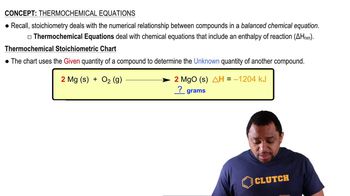
 01:13
01:13