Ch. 14 The Autonomic Nervous System and Homeostasis
Amerman- Human Anatomy & Physiology 3e
Amerman3rd EditionHuman Anatomy & PhysiologyISBN: 9780138247201, 9780138247928, 9780138201814Non è quello che usi tu?Cambia libro di testo
Capitolo 14, Problema 3

Sympathetic preganglionic neurons synapse:


a. directly on target cells.
b. on skeletal muscle fibers.
c. on sympathetic chain or collateral ganglia.
d. on vagal ganglia.

Guida verificata passo dopo passo
1
Understand the role of sympathetic preganglionic neurons in the autonomic nervous system. These neurons originate in the thoracolumbar region of the spinal cord and are part of the sympathetic division, which is responsible for the 'fight or flight' response.
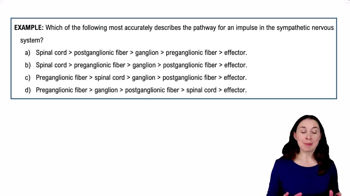
Recall that preganglionic neurons do not directly innervate target cells. Instead, they synapse with postganglionic neurons, which then innervate the target cells or organs.
Identify the location where sympathetic preganglionic neurons synapse. They typically synapse in ganglia, which are clusters of neuronal cell bodies located outside the central nervous system.
Differentiate between the types of ganglia in the sympathetic division. Sympathetic preganglionic neurons synapse either in the sympathetic chain ganglia (paravertebral ganglia) or in collateral ganglia (prevertebral ganglia). These ganglia are strategically located to relay signals to various target organs.
Eliminate incorrect options based on anatomical knowledge: (a) is incorrect because preganglionic neurons do not directly synapse on target cells; (b) is incorrect because skeletal muscle fibers are controlled by the somatic nervous system, not the autonomic nervous system; (d) is incorrect because vagal ganglia are associated with the parasympathetic division, not the sympathetic division.

Risposta video verificata per un problema simile:

Questa soluzione video è stata consigliata dai nostri tutor come utile per risolvere questo problema.

Concetti chiave

Ecco i concetti essenziali che devi comprendere per rispondere correttamente alla domanda.

Sympathetic Nervous System

The sympathetic nervous system is a part of the autonomic nervous system responsible for the body's 'fight or flight' response. It prepares the body for stressful situations by increasing heart rate, dilating pupils, and redirecting blood flow to essential organs. Understanding its role is crucial for analyzing how sympathetic preganglionic neurons function.
Video consigliato:
1:21
Sympathetic Nervous System Example 3

Preganglionic Neurons

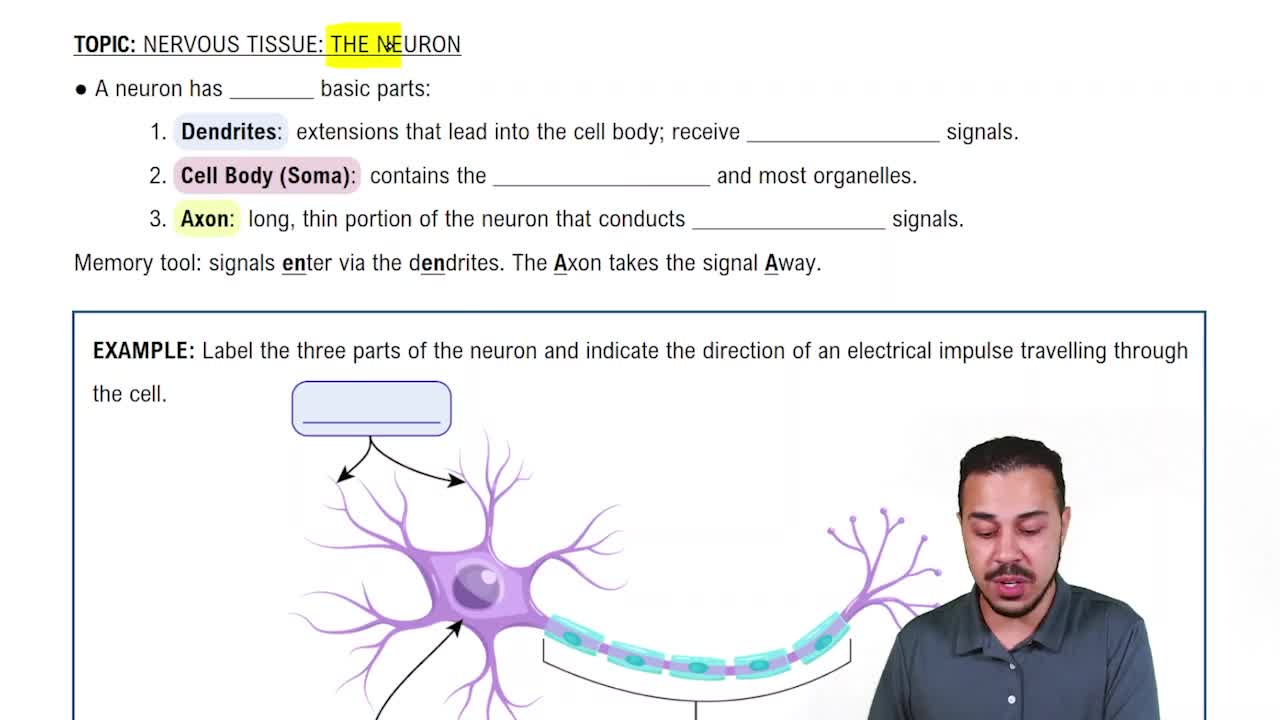
Preganglionic neurons are the first neurons in the autonomic nervous system pathway, originating in the central nervous system and synapsing with postganglionic neurons in ganglia. In the sympathetic nervous system, these neurons typically synapse in the sympathetic chain or collateral ganglia, which is essential for understanding their role in transmitting signals to target organs.
Video consigliato:
04:20
The Neuron

Ganglia

Ganglia are clusters of nerve cell bodies located outside the central nervous system. In the context of the sympathetic nervous system, they serve as relay points where preganglionic neurons synapse with postganglionic neurons. This concept is vital for understanding the pathways through which sympathetic signals are transmitted to various target tissues.
Video consigliato:
2:37
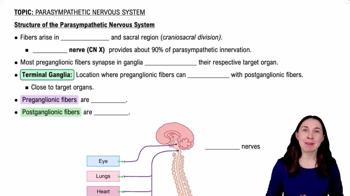
Structure of the Parasympathetic Nervous System
Pratica correlata
Domanda del libro di testo

Describe all the changes initiated by the parasympathetic nervous system that will take place when you finish the race. How will these changes maintain homeostasis?

696
views

Domanda del libro di testo

Which cranial nerves would be affected by a drug that stimulates the parasympathetic nervous system? Predict potential adverse effects that one might experience.

631
views
Domanda del libro di testo

A patient, Dr. Young, has both asthma and high blood pressure. Her physician prescribed the drug propranolol to treat her hypertension; this drug blocks all types of β-adrenergic receptors. She also takes the drug albuterol for asthma, which activates β2 receptors on bronchial smooth muscle. Will the pairing of these two drugs cause problems for Dr. Young? Explain.

642
views
Domanda del libro di testo

Mr. Chevalier has been diagnosed with Horner syndrome, which is caused by dysfunction of the sympathetic neurons in the superior cervical ganglion that innervate structures of the head, face, and neck. What symptoms is Mr. Chevalier likely to face due to his disease? Explain.

767
views
Domanda del libro di testo

Common findings in heart failure are fluid retention by the kidneys and stimulation of the heart by the sympathetic nervous system. How would both of these findings help the body to compensate for the failing heart?

588
views
Domanda del libro di testo

The drug neostigmine blocks the activity of the enzyme acetylcholinesterase in the synaptic cleft. Predict the effects of this drug.

761
views