Ch. 3 Cells and Tissues
Marieb - Essentials of Human Anatomy & Physiology 13th Edition
Marieb13th EditionEssentials of Human Anatomy & PhysiologyISBN: 9780135624340Non è quello che usi tu?Cambia libro di testo
Capitolo 3, Problema 20

Contrast cytokinesis, interphase, and mitosis.

Guida verificata passo dopo passo
1
Understand the cell cycle: The cell cycle consists of interphase, mitosis, and cytokinesis. Interphase is the preparatory phase, mitosis is the division of the nucleus, and cytokinesis is the division of the cytoplasm.
Define interphase: Interphase is the longest phase of the cell cycle, during which the cell grows, performs its normal functions, and prepares for division. It consists of three subphases: G1 (cell growth), S (DNA replication), and G2 (preparation for mitosis).
Explain mitosis: Mitosis is the process of nuclear division, where the replicated DNA is evenly distributed into two daughter nuclei. It consists of four stages: prophase, metaphase, anaphase, and telophase. Each stage ensures the accurate segregation of chromosomes.
Describe cytokinesis: Cytokinesis is the final step of cell division, where the cytoplasm is divided to form two separate daughter cells. In animal cells, this occurs through the formation of a cleavage furrow, while in plant cells, a cell plate forms to separate the cells.
Contrast the processes: Interphase is a preparatory phase focused on growth and DNA replication, mitosis is the division of the nucleus ensuring genetic material is distributed, and cytokinesis is the physical division of the cell into two distinct daughter cells.

Risposta video verificata per un problema simile:

Questa soluzione video è stata consigliata dai nostri tutor come utile per risolvere questo problema.
Durata del video:
1m

Concetti chiave

Ecco i concetti essenziali che devi comprendere per rispondere correttamente alla domanda.

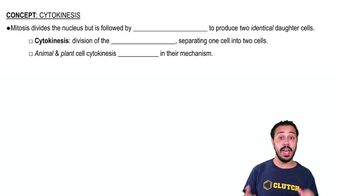
Cytokinesis

Cytokinesis is the final stage of cell division, occurring after mitosis, where the cytoplasm of a parental cell is divided into two daughter cells. This process involves the formation of a cleavage furrow in animal cells or a cell plate in plant cells, ensuring that each daughter cell receives the necessary organelles and cytoplasmic components. It is crucial for the successful completion of cell division and the maintenance of proper cell function.
Video consigliato:

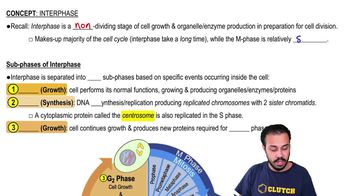
Interphase

Interphase is the longest phase of the cell cycle, during which the cell prepares for division. It consists of three sub-phases: G1 (cell growth), S (DNA synthesis), and G2 (preparation for mitosis). During interphase, the cell undergoes metabolic activities, duplicates its DNA, and synthesizes proteins necessary for mitosis, ensuring that the daughter cells will have the correct genetic material and resources.
Video consigliato:

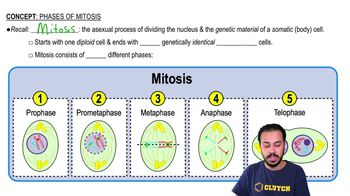
Mitosis

Mitosis is the process of nuclear division that results in the formation of two genetically identical daughter nuclei from a single parent nucleus. It is divided into several stages: prophase, metaphase, anaphase, and telophase, each characterized by specific events such as chromosome alignment and separation. Mitosis is essential for growth, tissue repair, and asexual reproduction in organisms, ensuring genetic continuity across generations.
Video consigliato:
Percorso guidato
03:21
Phases of Mitosis