Ch. 3 Cells and Tissues
Marieb - Essentials of Human Anatomy & Physiology 13th Edition
Marieb13th EditionEssentials of Human Anatomy & PhysiologyISBN: 9780135624340Non è quello che usi tu?Cambia libro di testo
Capitolo 3, Problema 17

Describe the general characteristics of epithelial tissue. List the most important functions of epithelial tissues, and give examples of each.

Guida verificata passo dopo passo
1
Epithelial tissue is characterized by tightly packed cells with minimal extracellular matrix, forming continuous sheets. It is avascular (lacks blood vessels) but innervated, meaning it relies on diffusion from underlying connective tissues for nutrients and waste removal.
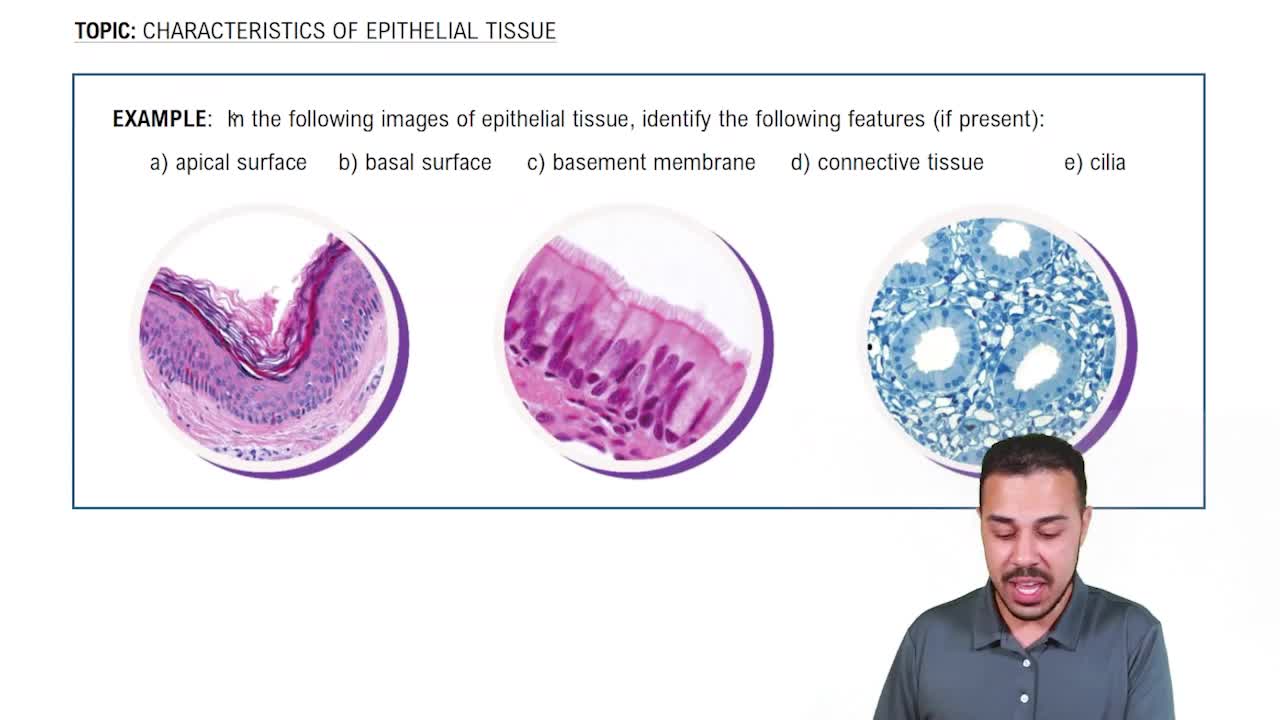
Epithelial tissue exhibits polarity, with an apical surface (exposed to the external environment or internal cavity) and a basal surface (attached to the basement membrane, which anchors the epithelium to underlying connective tissue).
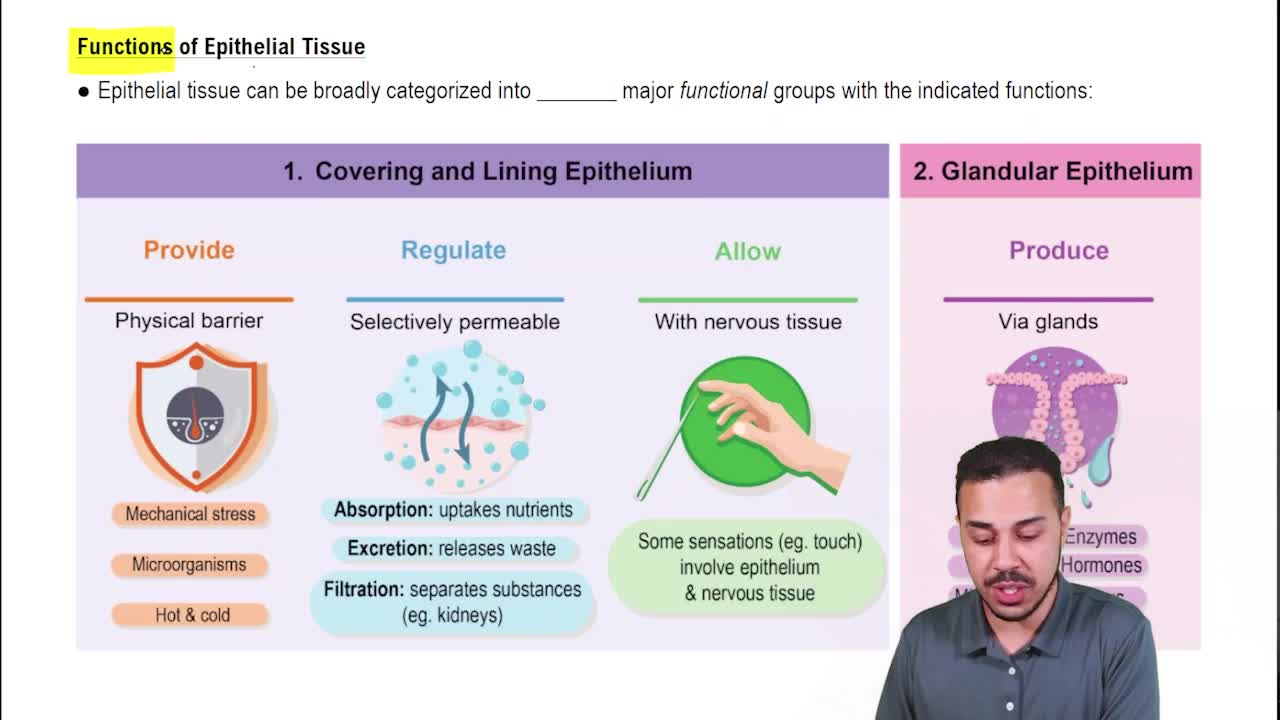
The primary functions of epithelial tissue include protection, absorption, secretion, filtration, and sensory reception. Each function is associated with specific types of epithelial cells adapted to their roles.
Examples of epithelial tissue functions: Protection is provided by stratified squamous epithelium, such as the skin, which acts as a barrier against mechanical injury and pathogens. Absorption occurs in simple columnar epithelium, such as the lining of the small intestine, where nutrients are absorbed. Secretion is performed by glandular epithelium, such as in sweat glands or the pancreas. Filtration occurs in simple squamous epithelium, such as in the kidneys' glomeruli, where blood is filtered to form urine.
Sensory reception is facilitated by specialized epithelial cells, such as those in the taste buds or olfactory epithelium, which detect stimuli and relay signals to the nervous system.

Risposta video verificata per un problema simile:

Questa soluzione video è stata consigliata dai nostri tutor come utile per risolvere questo problema.
Durata del video:
2m

Concetti chiave

Ecco i concetti essenziali che devi comprendere per rispondere correttamente alla domanda.

Characteristics of Epithelial Tissue

Epithelial tissue is characterized by closely packed cells with minimal extracellular matrix, forming continuous sheets. It has polarity, with an apical surface facing the body exterior or cavity and a basal surface attached to the underlying connective tissue. Epithelial tissues are avascular, relying on diffusion for nutrient supply, and have a high regenerative capacity, allowing for rapid healing and replacement.
Video consigliato:
07:45
Characteristics of Epithelial Tissue Example 1

Functions of Epithelial Tissue

Epithelial tissues serve several essential functions, including protection, absorption, secretion, and sensation. For example, the skin's epidermis protects against environmental damage, while the intestinal epithelium absorbs nutrients. Glandular epithelium is responsible for secretion, such as hormones or enzymes, and sensory epithelium contains specialized cells for detecting stimuli.
Video consigliato:
07:25
Functions of Epithelial Tissue

Types of Epithelial Tissue

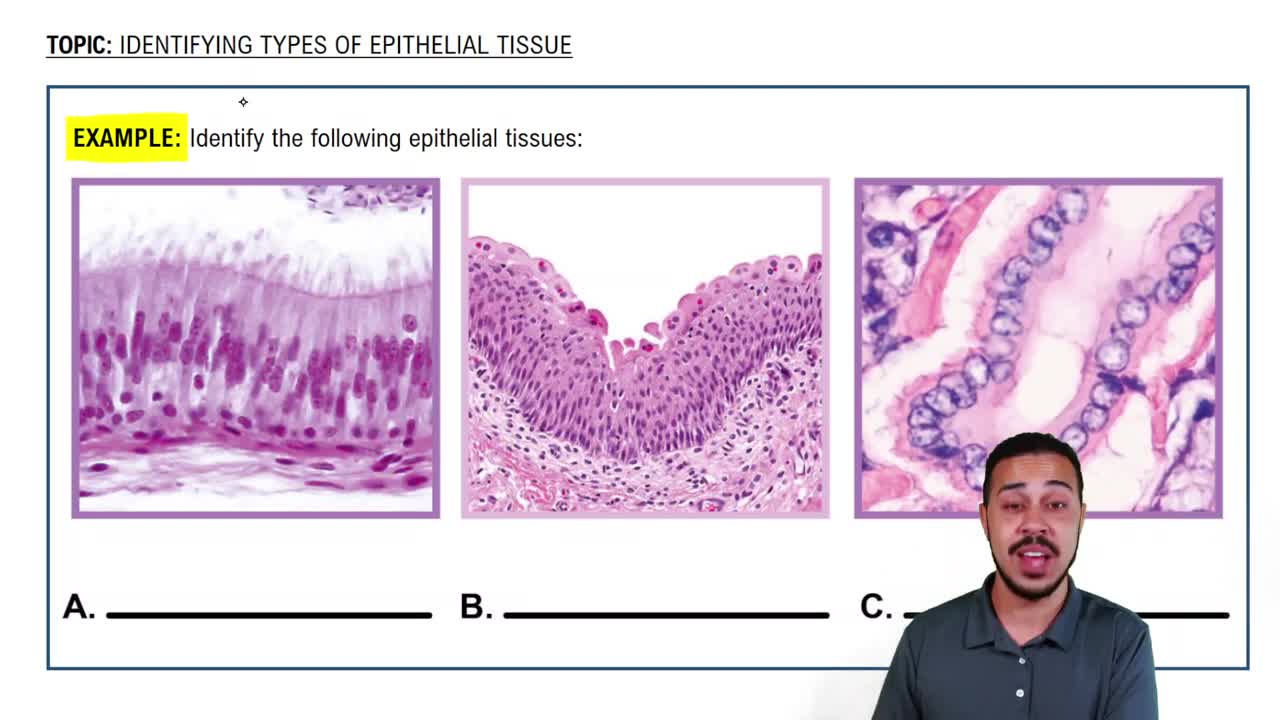
Epithelial tissue is classified based on cell shape and arrangement. The main types include simple (single layer) and stratified (multiple layers) epithelium, as well as squamous (flat), cuboidal (cube-shaped), and columnar (tall and column-like) cells. Each type is adapted to specific functions; for instance, simple squamous epithelium facilitates diffusion in the lungs, while stratified squamous epithelium provides protection in areas like the skin.
Video consigliato:
07:25
Identifying Types of Epithelial Tissue Example 1